For over a century, society held a fundamental agreement: Photographs and audio recordings actively represent physical reality. If we had a photograph of an event, we possessed objective proof of its existence.
Within a span of roughly 24 months, generative AI diffusion methodologies permanently destroyed that social contract. Synthesizing hyper-realistic deepfake audio of political leaders, constructing fake video footage of military actions, and fabricating non-consensual imagery is incredibly simple. We are entering an era where you can no longer trust your own eyes. We must now rely entirely on math.
The Collapse of Photographic Evidence
The danger of AI does not strictly lie in its ability to generate fiction. It lies perfectly in the Zero Marginal Cost of deception. Previously, faking a video of a politician required a massive Hollywood VFX studio and millions of dollars.
Now, a sophisticated phishing scammer can clone your CEO's exact vocal timbre by stealing a 5-second voice clip from their public LinkedIn video. They can then dynamically use AI voice models to call your finance department simulating the CEO, instructing an emergency wire transfer.
Why Watermarks are Useless
Many governments are proposing legislation demanding that AI companies invisibly "watermark" algorithmic data. However, open-source AI infrastructure fundamentally negates this approach. A bad actor running a localized Uncensored LLM or image generator on their personal computer graphics card completely bypasses any corporate firewalls or legal API limits.
Prove your data integrity
The only way to prove a digital file has not been maliciously manipulated by AI is to calculate its cryptographic signature. Anchor the exact pixel bytes into an irreversible mathematically verified hash lock.
Launch SHA-256 Cryptographic ToolCryptographic Hashes as the Solution
Instead of trying to label what is "Fake", society must flip the paradigm and cryptographically label exactly what is "Real".
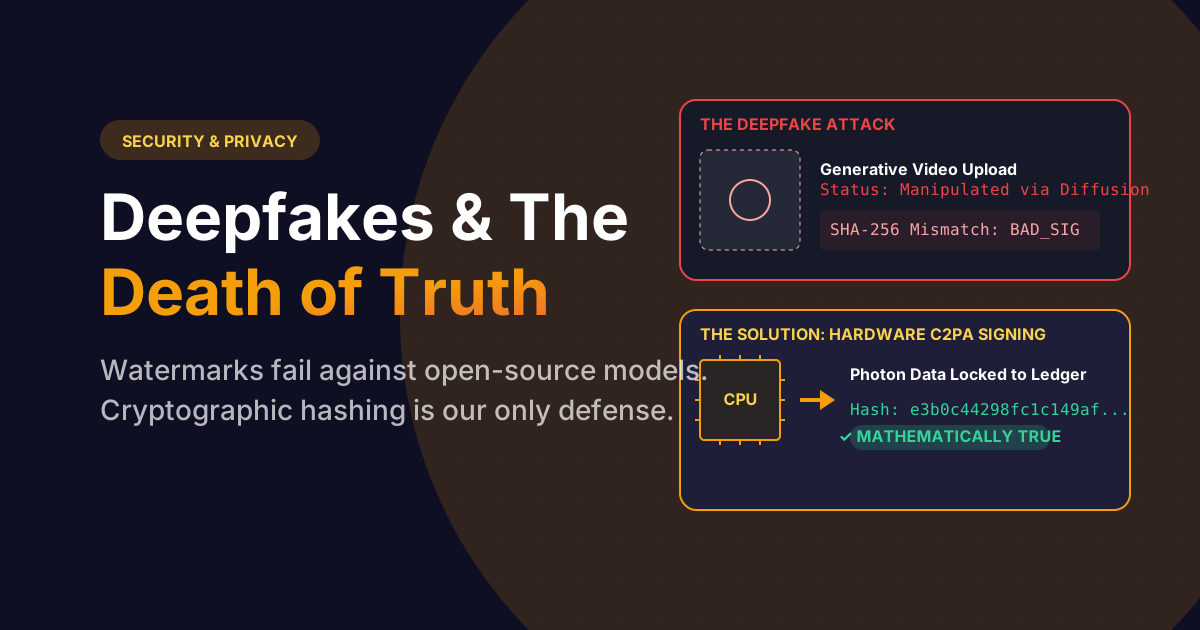
Camera hardware manufacturers like Sony and Nikon are beginning to embed native Cryptographic Signing hardware directly onto the silicon sensor chip. The instant a camera takes a photograph, it mathematically calculates an irreversible **SHA-256 Hash signature** of the raw photons. That hash is instantly appended to the image metadata and uploaded to a rigid cloud ledger.
If a media outlet downloads that photo and uses AI to secretly add angry protesters into the background, the altered pixel data fundamentally changes the mathematical equation. The original SHA-256 hash completely breaks, flashing a massive warning to the public that the file has been algorithmically tampered with.
Frequently Asked Questions
Not reliably. While "AI Detection" tools exist on the market, they are notoriously susceptible to false positives. They actively trigger and punish completely authentic human writers just because the human used simple, highly predictive sentence structures.
The Coalition for Content Provenance and Authenticity (C2PA) is a massive tech consortium (Adobe, Microsoft, Intel) attempting to build the exact open cryptographic standard that physically tracks the "history" of an image from the moment it is snapped by a camera all the way to its final rendering block on social media.
For extreme corporate security, many companies are instituting "Safe Words." If a CEO calls demanding a massive wire transfer, the employee demands the pre-agreed arbitrary safe word sequence that the AI model could not possibly know, no matter how perfect the voice deepfake sounds.