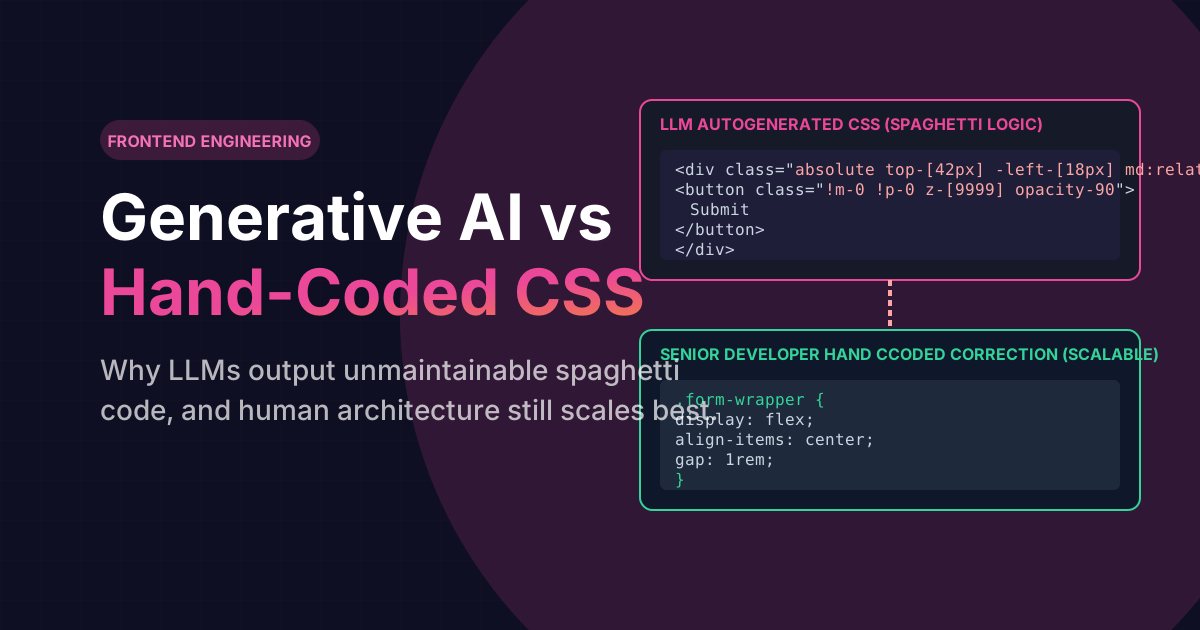
The single most viral narrative in Silicon Valley over the past two years is that AI Code Assistants like GitHub Copilot and Claude-3 will explicitly annihilate the entire "Frontend Developer" job class. The hypothesis is: Why pay a developer $120k for a web app when an LLM can generate a massive React landing page via a single text prompt?
While AI can magically generate the opening boilerplate script of your application seamlessly, trying to force an LLM to accurately patch a granular, deeply specific CSS Flexbox alignment collision bug on a live production repository is physically agonizing. Hand-coding CSS structure is nowhere near dead.
The Death of Boilerplate Architecture
Where AI exclusively excels is Initialization Velocity. Five years ago, starting a React web application required manually typing massive amounts of identical router files, boring component wrappers, and repetitive Tailwind layouts. Today, an LLM handles the first 80% of development natively in an instant.
If you ask an AI: "Generate a classic SaaS pricing tier widget component", it performs phenomenally because its neural dataset ingested millions of identical 3-column pricing structures off GitHub. But the exact second your client demands highly custom, non-standard visual architecture—like a scrolling 3D scroll-triggered animation synced to the SVG background—the AI model instantly detonates.
Format Hallucinated AI Code
LLMs are infamous for generating horrific, completely unstructured inline styles. Before attempting to debug an AI-generated style block, structurally format the nested syntax hierarchies using our dedicated pipeline tool to visually map the code architecture.
Launch CSS Formatter & BeautifierThe Responsive Breakpoint Chaos Loop
CSS relies fundamentally on extreme cascading temporal logic. If you change a global `flex-wrap: nowrap` property in the mobile breakpoint variable, it explicitly triggers a physical butterfly effect crashing the layout geometry on the massive 4K desktop monitor screen view.
Because LLMs technically "forget" the massive web of global repository connections outside their immediate text token window, they frequently attempt to "fix" a mobile UI bug by permanently ripping out the entire desktop geometry rule. The human must aggressively step in, read the actual CSS lines, and execute targeted, localized, handcrafted style rules.
Frequently Asked Questions
More than ever. Future developers operate strictly as "Editors" rather than "Writers". If you do not intimately understand exactly how CSS Grid natively functions underneath the hood, you physically possess zero capability to debug or correct the garbage spaghetti code the AI generated for you.
No. Most default AI models heavily default to throwing hundreds of atomic utility classes completely directly into the HTML tag. When building enterprise logic, this rapidly creates completely unmaintainable bloated DOM strings unless forcefully prompted to utilize strictly modular classes.
The bleeding edge of UI design AI does not calculate text. A VAM physically runs a simulated web browser, looks at the rendered geometry pixels, calculates the padding overlap via mathematical computer vision, and automatically adjusts the layout values via real-time reinforcement visual training.