If you feed tools like Midjourney or DALL-E a text prompt like "Cyberpunk cityscape neon rain," the generative diffusion models output jaw-dropping, award-winning illustration art in exactly four seconds. Looking at the sheer fidelity of these generated pixel blocks has caused sheer panic across the creative industry.
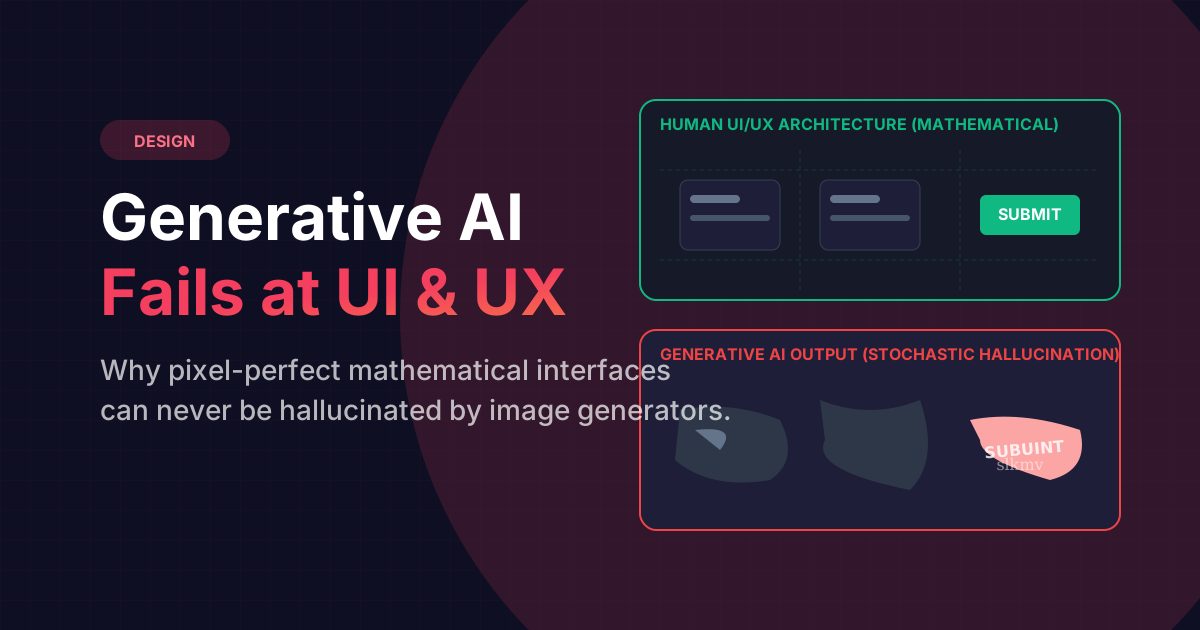
But when you inevitably try to prompt an AI with: "Design a sleek SaaS login screen interface," the final result is a terrifying, unusable nightmare. The button text is mangled, the geometric grid structure is fatally broken, and the contrast ratios completely fail accessibility standards. Why does AI fail so aggressively at UI design?
Abstract Art vs Logical Engineering
Text-to-Image models operate via "Diffusion." They start with TV static pixels and aggressively denoise the frame backward until highly probable visual patterns emerge. For abstract art, hallucination is explicitly a feature. If a cyberpunk building has 14 overlapping asymmetrical windows, the human eye interprets it as "cool and chaotic."
UI/UX Design is not art; it is rigid mathematical engineering. If a "Submit Order" button on an e-commerce website is asymmetrical by 4 pixels, or if the padding on the left is greater than the right, it psychologically signals to the user that the website is broken, broken resulting in massive cart abandonment.
The Mathematics of Usability Accessibility
AI does not calculate logic when choosing interface styling; it calculates probability. A diffusion model might color a button light gray with white text because that combination frequently appeared in its Dribbble training set of "minimalist aesthetic UI concepts."
The model is entirely unaware that the resulting contrast ratio legally violates the W3C Web Content Accessibility Guidelines (WCAG) for visually impaired hardware rendering logic. Human interface designers construct complex mathematical color scales ensuring absolute optical harmony.
Calculate Perfect Color HSL Harmony
Do not rely on stochastic AI probabilties for your application's critical branding hex codes. Use our mathematical generator to output mathematically proportional shade scales and rigidly accessible brand colors.
Launch Universal Color Palette ToolThe Flattened Pixel Problem
Even if an AI randomly generates a perfectly structured interface, it outputs a flattened `.PNG` or `.JPEG` raster file. Web interfaces are explicitly comprised of modular Document Object Model (DOM) container objects, dynamic vector SVGs, and responsive flex spacing.
A web developer cannot import a flattened JPEG prompt output. Generating an isolated vector icon or a functional React component is a structurally different architectural computational task than hallucinating an image array.
Frequently Asked Questions
Platform-native AI tools (like inside Figma) are incredibly useful for repetitive drudgery, like auto-renaming 50 layers or replacing placeholder content. However, they act as highly efficient layout copilots, not autonomous creative director architects directing complex user conversion flows.
LLMs (text models like Claude or GPT) write phenomenal functional CSS and HTML code. Text-to-Image models (diffusion models) cannot program. To generate a functional UI, you must use an LLM code generator, not an image generator.
According to current US Copyright Office guidelines, images generated entirely by AI artificial prompts without significant localized human modification legally lack human authorship and cannot be locked into corporate copyright protection architectures.