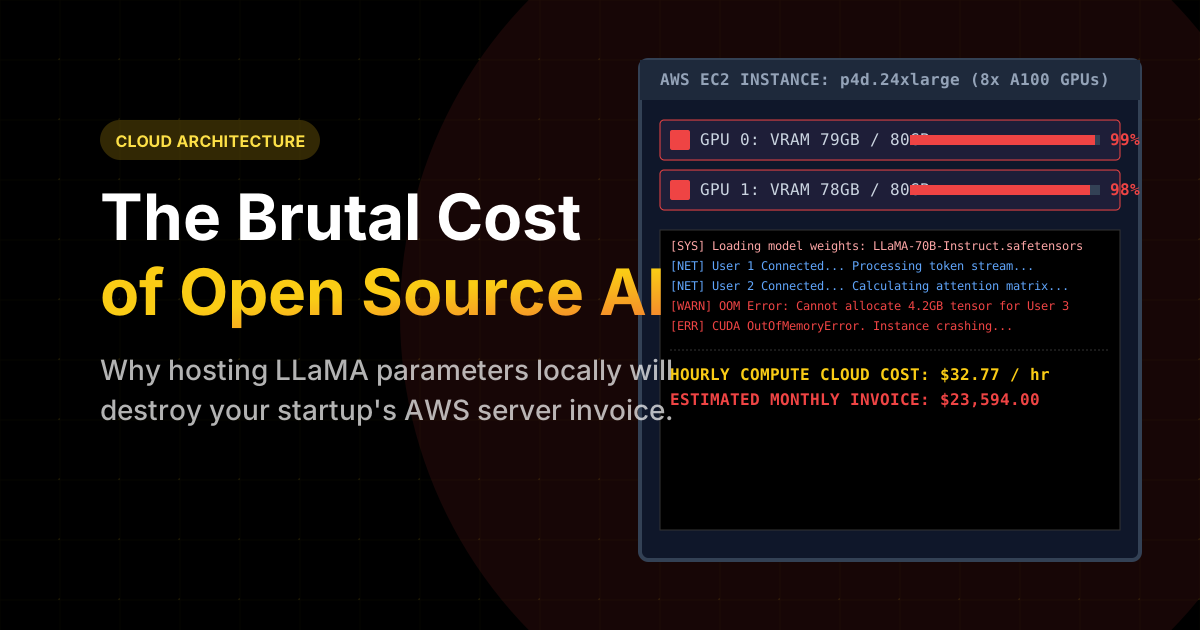
Developers globally celebrated when Meta unleashed the open-source LLaMA architectural weights perfectly legally into the open developer marketplace. Building a deeply integrated, highly private LLM application offline sounded like an immediate, zero-cost pivot.
But software is only half the equation. The second you deploy an open source 70B parameter model pipeline from your sandbox laptop to a live production server interacting with ten concurrent user inputs, the cloud architecture physics immediately trigger thousands of dollars in hidden GPU computation costs.
The Brutal VRAM Physical Limitation
Traditional computing strictly prioritizes the central CPU array and RAM. Unfortunately, executing generative AI inference matrix calculations relies almost exclusively on highly volatile, incredibly restricted GPU VRAM mapping memory.
To run a quantized 70 Billion parameter open-weight AI model fluidly at runtime, you mathematically require roughly 40 Gigabytes of isolated high-speed VRAM. Leasing an Nvidia A100 GPU cluster instance on AWS or Google Cloud to cover that exact VRAM profile rapidly scales upwards of thousands of dollars natively per single rental month.
Processing AI Vision Encoding Chains
When running Multimodal local AI flows, server transmission bandwidth creates massive bottlenecks. Before an LLM can execute advanced logic on a user-uploaded image, you cannot physically transmit the raw `.jpg` artifact directly. The image binary payload must be strictly converted into a serialized continuous vector protocol so the API can interpret the underlying optical tensor format.
Encode AI Vision Payloads Natively
Whenever pushing visual graphics directly into offline LLM pipelines via cURL POST requests, your pipeline must first universally convert the graphic file binary strictly into string architecture. Convert images seamlessly using our pipeline developer stringifier.
Launch Base64 Encoding ConverterScaling Concurrent GPU Users
The ultimate hidden horror occurs exactly during your traffic spike. A single high-end cloud GPU executing inference calculations physically blocks alternative incoming connections inside the sequence batch queue.
If three unique users click "Generate Answer" explicitly at the very same identical millisecond, User #3 violently waits mathematically in the queue until the GPU physically completes finishing printing the final syllable token for User #1. To scale up and serve multiple users across parallel endpoints flawlessly without lag delays, you must lease explicitly duplicated GPU instances, recursively multiplying your cloud hosting rental invoice.
Frequently Asked Questions
Quantization is the strict mathematical compression technique of rounding the immense 16-bit precision weights of an LLM downward aggressively into a smaller 4-bit float map. This degrades IQ minimally but massively shrinks the required internal server VRAM cost.
Yes, technologies like WebGPU strictly allow minimal models (like a tiny 3-Billion parameter engine) to run directly on the end-user's actual local laptop GPU via their Safari browser interface, offloading backend server hosting costs entirely to the customer network.
Open-source logic is overwhelmingly cheaper only if your enterprise routinely processes over five million distinct API tokens precisely every single day, or if highly secure privacy requirements mathematically forbid patient healthcare data from striking a third-party corporate server instance.