When you ask a Large Language Model (LLM) a highly complex analytical question, its fluid, essay-driven response creates an intense, terrifying illusion. It absolutely feels like a conscious entity sitting on the other side of the server, carefully evaluating the emotional weight of your English words before typing out a response.
But fundamentally, neural networks are physically incapable of understanding the English alphabet. AI does not "read" your prompt. It violently compresses your language down into brutal mathematical vectors and runs an advanced calculus probability map. The secret sauce powering this translation is Tokenization.
The Illusion of LLM Comprehension
Computers strictly process numerical floats. To feed the word "Apple" into an AI transformer model, we must map those letters into a structural lookup database. But AI architecture doesn't slice arrays by individual letters (A-P-P-L-E). Doing so strips out contextual meaning entirely.
Instead, AI groups heavily used syllables and structural fragments into what are called Tokens.
What is a Token?
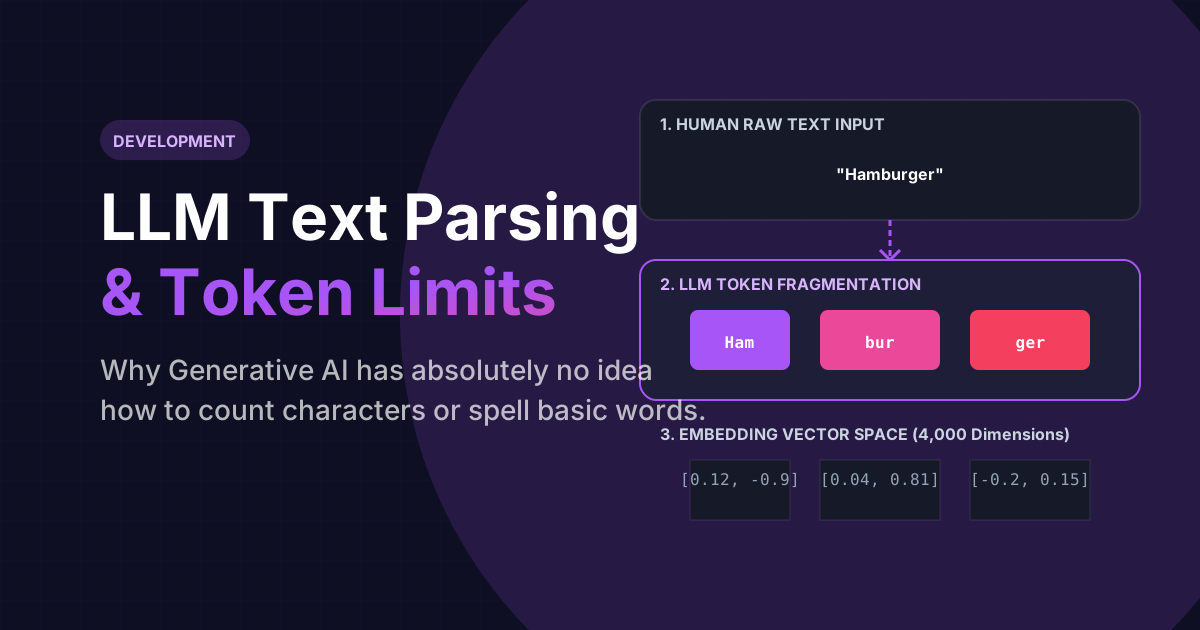
A "Token" is typically around `0.75` of a word. Very common words like `"The"` or `"Dog"` act cleanly as a single monolithic computational token. However, a highly complex multisyllabic word like `"Hamburger"` is instantly severed by the tokenizer into multiple underlying fragments (e.g. `Ham` + `bur` + `ger`).
This is why AI API pricing is explicitly billed "Per 1,000 Tokens" rather than by raw Word Count. The internal AI engine cares exclusively about the fragmented mathematical volume of syllables processing through the neural layer.
Calculate Prompt Sizing Context
Whenever you feed an AI contextual knowledge bases, you are eating into the limited Context Window capacity. Use our strict counter utility to instantly calculate the exact string volume inside your text prompt before querying high-cost payload APIs.
Launch Text Character CounterSpatial Embeddings and Vectors
Once converted to Tokens, the AI runs these fragments through an "Embedding Representation." It translates the token into a 4,000-dimensional mathematical coordinate map. In this 4D space, the coordinate for "King" minus the geometric coordinate for "Man" plus the geometric coordinate for "Woman" literally equals the exact point in space mapped for "Queen". This is how AI grasps contextual "Meaning".
Why AI Struggles with Simple Logic
This tokenize-to-vector system perfectly explains why highly advanced LLMs occasionally fail hilariously simple tasks. If you ask an AI "How many R's are in the word Strawberry?", older models often confidently declare there are only two.
Why? Because the AI doesn't see the letters S-T-R-A-W-B-E-R-R-Y. The tokenizer brutally severed the word into three distinct chunks: `Straw`, `ber`, `ry`. The AI neural net assesses the three macro-components probabilistically instead of counting individual atomic characters.
Frequently Asked Questions
The Context Window is the strict hardware memory limitation of the text the AI can "hold" simultaneously. If an AI has an 8,000 token limit context window, it physically forgets what you said on page 1 the absolute second you feed it page 10.
Brutally yes. Because Western companies built the tokenizers strictly optimized for English syntax, an English word might equal 1 token. But processing the exact same word in Arabic or Mandarin might shatter into 4 or 5 discrete fallback tokens. Therefore, asking the API the exact same question in Arabic costs you significantly more compute credit money.
LLMs are frozen parameter weights; they cannot actively search the internet safely. RAG architecture involves you writing a Python script that searches the internet first, downloads the relevant text paragraph, strings it directly into the initial prompt, and tells the AI: "Base your logic explicitly on what I just provided you."