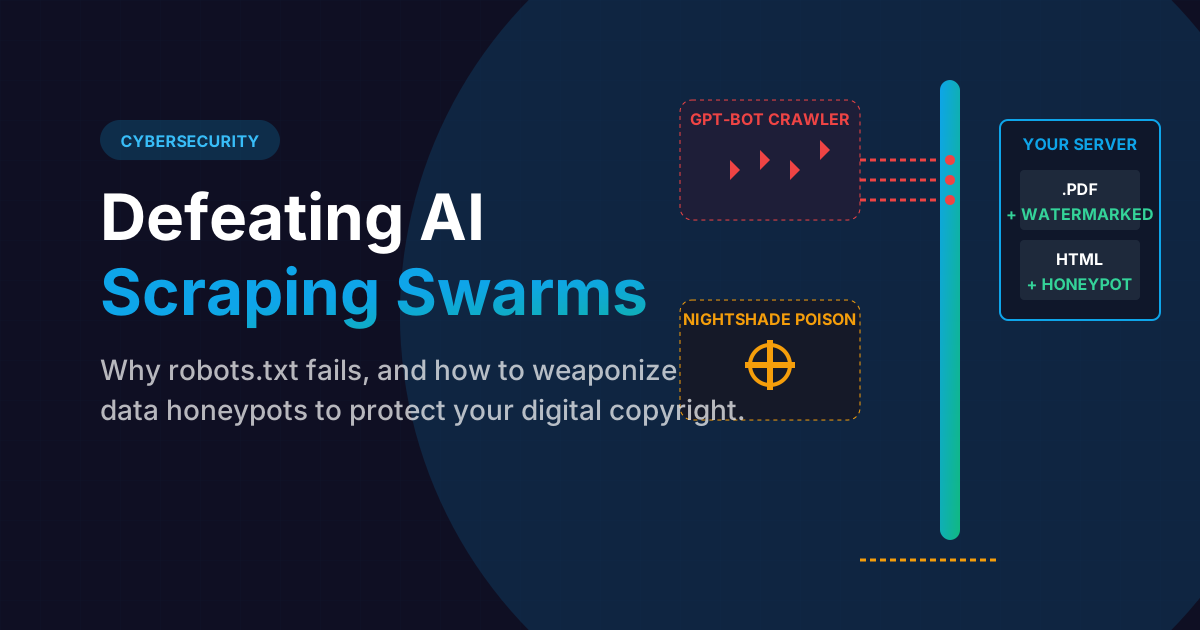
Every single day, advanced server arrays operated by billion-dollar tech giants crawl the public internet. Their objective is exceedingly simple: mechanically devour millions of gigabytes of your personal blog text, corporate documents, and digital art to train their next-generation Large Language Models. They do not ask for copyright permission, and they certainly do not pay you royalties.
If you are an independent creator or a corporate entity publishing digital property online, you must proactively architect extreme defensive measures to brutally restrict algorithmic ingestion.
The Failure of Robots.txt
Historically, the polite method of stopping web crawlers (like Googlebot) was simply declaring explicit restrictions in your `robots.txt` root file (`User-agent: GPTBot Disallow: /`).
This protocol fundamentally failed. While legitimate mega-corporations technically honor the `robots.txt` request for PR optics, thousands of "rogue" scraping arrays completely ignore the text file outright. To physically block a rogue scraper, you must deploy aggressively hostile Cloudflare WAF bot-challenge protocols targeting headless browser agents directly.
Lock Down Your Corporate PDF Documents
Never upload raw proprietary contract texts or client manuscripts to the open internet. Aggressively map irreversible digital watermarks directly over your PDF architecture to ruin raw text OCR mapping entirely.
Launch PDF Watermark UtilityData Scraping and the Fair Use Loophole
Why is this entirely legal? Current corporate legal teams leverage the US "Fair Use" doctrine, radically arguing that scraping your copyrighted material is not theft because the resulting LLM model parameters are incredibly "highly transformative." Until global precedent court cases definitively declare ingestion illegal, you must assume your data is an open target.
Deploying AI Honeypots
Modern cybersecurity protocol now specifically encourages "Data Poisoning." Website administrators explicitly program hidden hyperlink `
Human readers physically cannot see the fake article text. But the automated Python Web Scraper bot reads the raw DOM sequentially, blindly scraping the garbage data into the AI training matrix. By aggressively infecting the system with hallucinated syntax logic, developers purposely ruin the accuracy logic arrays of the offending scraping models.
Frequently Asked Questions
Nightshade is a revolutionary localized algorithm heavily utilized by digital artists. It structurally calculates imperceptible pixel-level poisoning algorithms directly onto an uploaded illustration. To human eyes, it looks identical. But if a Diffusion AI scrapes the image, the pixel poison mathematically destroys the model's spatial rendering arrays.
Barely. Older text CAPTCHAs are instantly solved natively by minimal local LLM vision architectures. Modern defense systems rely strictly on invisible background telemetry (like tracking random mouse drift jitter patterns and keyboard latency variations) rather than solving actual puzzle images.
If an LLM verbatim regurgitates your explicitly exact copyrighted manuscript output without hallucination error (known strictly as "Regurgitation Overfitting"), you absolutely possess significantly heavy grounds for a DMCA legal strike, as it breaches the "transformative" layer of the Fair Use defense.