For all the terrifying, omnipotent capabilities of modern Large Language Models, developers frequently assume that AI has completely replaced classical computer science. The assumption is that you can simply feed an AI a massive blob of chaotic, unstructured text data and say, "Extract the phone numbers for me."
While an LLM can absolutely do this, deploying it into a production server at scale is a devastating engineering mistake. The multibillion-dollar foundation models produced by OpenAI and Anthropic natively rely on a 1950s technology: Regular Expressions (Regex). Here is why the modern AI revolution is secretly held together by ancient string-matching mathematics.
The Hallucination of Stochastic AI Validation
When you ask an AI to validate whether a string of text is a properly formatted CSS hex code or a valid Email domain, the Neural Network does not "know" the answer. It calculates the probabilistic likelihood sequence of English vectors that look similar to the correct answer. This mathematical layout inherently means the AI will occasionally hallucinate.
You cannot tolerate a 2% hallucination failure rate when processing enterprise billing transactions. A hardcoded Regex block (`^[a-zA-Z0-9+_.-]+@[a-zA-Z0-9.-]+$`) guarantees a 100% rigid mathematical truth test. It executes instantly on a CPU, taking zero milliseconds, whereas an AI API takes exactly 1,200 milliseconds and costs actual money per token.
Garbage In, Garbage Out
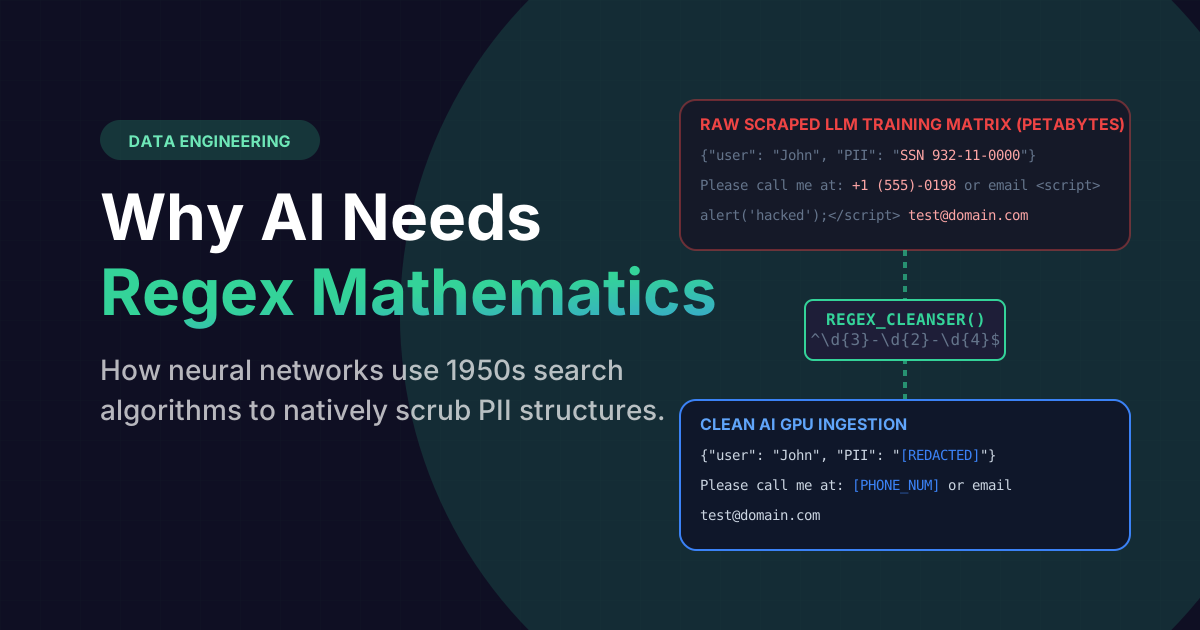
To train highly coherent frontier AI platforms (like GPT-4), the central training sequence requires aggressively scraping the entire open internet. The raw internet is infested with invisible unicode characters, broken `