In 2008, rendering a website was magnificently simple: You declared a `.container` width as exactly `960px`, firmly anchored your margins, and walked away. The iPhone violently shattered that mathematical paradigm overnight by injecting chaotic viewport dimensions across millions of disparate screen arrays.
Today, utilizing raw pixels for sizing layout containers or typography is universally considered an architectural web design sin. Modern UI engineering relies exclusively on elastic fluid geometry algorithms.
The Mathematical Pixel Trap
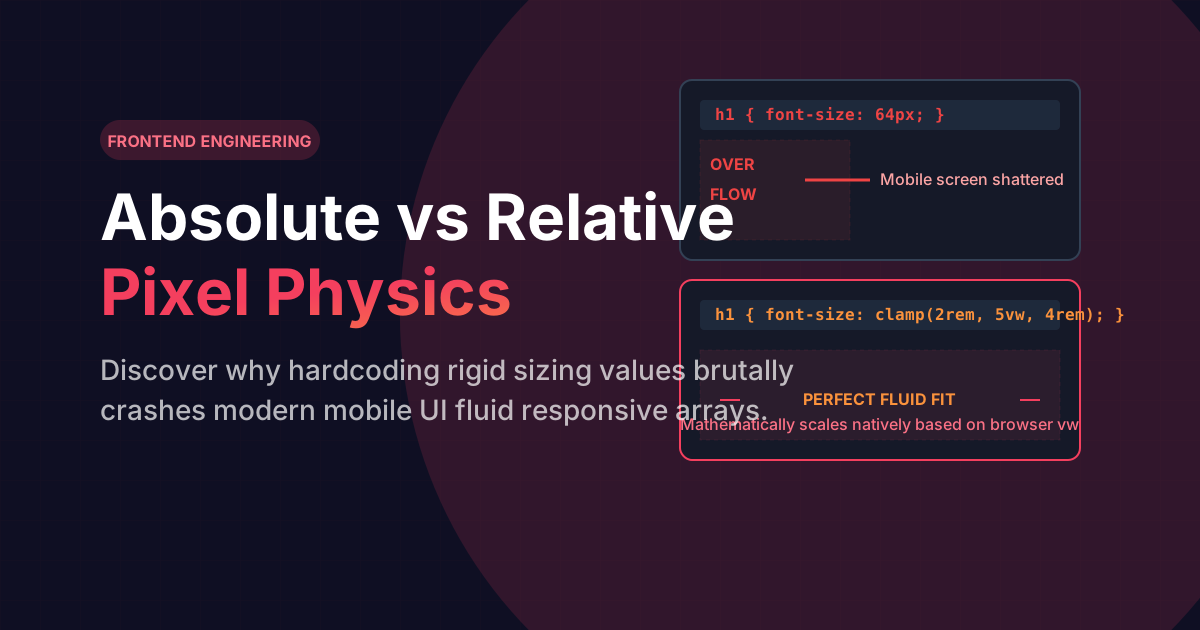
An absolute pixel (`px`) is stubbornly rigid. If you strictly command your blog's `
` title to be exactly `64px`, it will perfectly mathematically render 64 pixels wide across a desktop monitor.
However, when a user intensely attempts to natively read your blog on a 320-pixel wide older mobile phone device, a 64-pixel font width physically consumes over two entire rows of text for one single word. The user experiences devastating structural overflow, triggering horizontal scrolling blocks that inherently destroy conversion rates immediately.
Mathematically Redefine Aspect Dimensions
Do not accidentally slice critical optical visual layouts during responsive shifting breakpoints. Utilize our native mechanical aspect resizer tool to flawlessly recalculate vector graphic widths explicitly before DOM injection.
Launch Dynamic Pixel Math ResizerThe Root EM (REM) Revolution
To mathematically combat layout collapse, architectural developers deployed the Relative Root Unit (REM). Unlike normal pixels, REM physically maps to the foundational HTML root font scaling logic of the exact local web browser (which defaults locally to roughly `16px`).
If you declare your margin width as explicitly `4rem`, you are mathematically commanding: "Calculate four times the absolute size of the user's localized browser preference." If a visually impaired user physically alters their browser settings to enlarge text inherently to `24px` for accessibility, your exact layout dynamically expands naturally right alongside them.
Fluid Typography Mathematics
The bleeding edge of UI design has permanently abandoned fixed media queries (`@media (max-width:...)`) entirely in favor of the hyper-advanced CSS `clamp()` protocol.
By declaring `font-size: clamp(1rem, 5vw, 3rem);`, you physically instruct the browser engine processor to dynamically render the exact typography width strictly relative to the physics of the overarching viewport window scaling smoothly and fluidly without jarring block breakpoints ever natively triggering.
Frequently Asked Questions
No. Standard `em` explicitly physically scales relative to its direct parent DOM container natively, which fundamentally creates horrifying multiplicative layout-bloat bugs when nested deeply internally.
Percentage mathematics strictly respect the bounding box logic of the parent container array. `Viewport Width (vw)` ignores all internal nesting hierarchies natively and logically scales perfectly directly to the full physical monitor screen array.
Pixes are still overwhelmingly mandatory for absolute mathematical microscopic borders (`border: 1px solid`), deeply complicated shadow diffusion matrices, and rigid optical baseline grid layout alignments.