You see them stamped mercilessly across restaurant tables, billboard advertisements, and boarding passes. The Quick Response (QR) Code is arguably the most globally utilized localized physical data-transfer methodology on Earth.
What inherently makes a QR Code so phenomenally resilient isn't the black square ink—it is the intensely complicated aerospace mathematical correction algorithms physically encoded permanently into the pixel grid.
The Three Eye Constellations
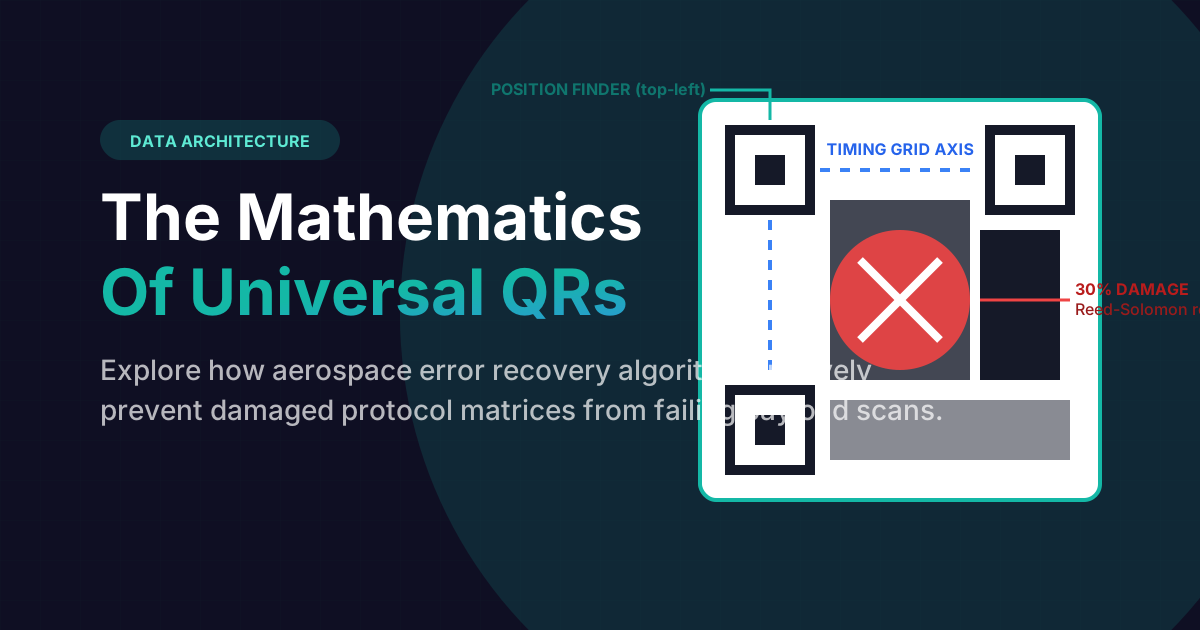
When you point your incredibly chaotic, shaking mobile phone camera at a severely tilted physical QR code, the AI parsing engine must mathematically orientation-lock immediately. It explicitly hunts for the Finder Patterns (the three giant square targets universally anchored on the top-left, top-right, and bottom-left boundaries).
Simultaneously, a tiny dotted explicit axis line (the Timing Pattern) natively connects the three targets. The processor counts the exact number of dots natively spanning between the structural eyes, fundamentally calculating the grid dimension resolution geometry before reading a single line of real underlying data.
Compile Encryptable Protocol Matrices
Do not accidentally misconfigure underlying error correction thresholds manually. Mechanically bind complex string variables seamlessly into dense functional optical arrays utilizing our native generator matrix.
Launch Native Protocol QR GeneratorReed-Solomon Error Correction Magic
If you take a permanent black sharpie and violently cross out highly critical sections of a UPC Barcode array, the barcode explicitly dies instantly. If you literally rip a QR code fully in half physically, it effortlessly scans correctly.
QR vectors utilize the phenomenal Reed-Solomon Error Correction polynomial algorithm natively utilized by NASA to retrieve completely shattered radio signals from deep space Jupiter probes. The generator redundantly over-calculates and replicates specific block math throughout the matrix, structurally guaranteeing that even if exactly 30% of the entire grid is obliterated, the algorithm inherently mathematically recalculates the missing syntax strings on the fly.
Why Custom Logos Don't Crash Outputs
Because designers deeply understand the immense power of Level H (30%) Error redundancy, they routinely maliciously permanently overwrite the direct center grid logic block by visually explicitly pasting a corporate logo graphic flat over the active data physics.
The decoding engine structurally views this logo explicitly as "Severe Matrix Damage", natively triggers the mathematical polynomial restoration engine, and instantaneously bypasses the broken logo chunk entirely, pulling the identical data sequentially from the unaffected redundancy borders seamlessly.
Frequently Asked Questions
A maximum Version 40 QR grid architecture actively natively supports exactly 7,089 numerical characters natively, or roughly 4,296 pure alphanumeric syntax letters completely perfectly.
Every single letter absolutely mandates mathematically unique square blocks. A 100-character URL geometrically forces the generator directly into a significantly denser grid matrix array, which requires substantially higher resolution camera lens scans natively.
Technically yes, however heavily discouraged. The absolute vast majority of low-end decoding logic processors are algorithmically strictly globally hardcoded natively to search exclusively for pure black vector lines placed explicitly strictly on high-contrast white bounds.