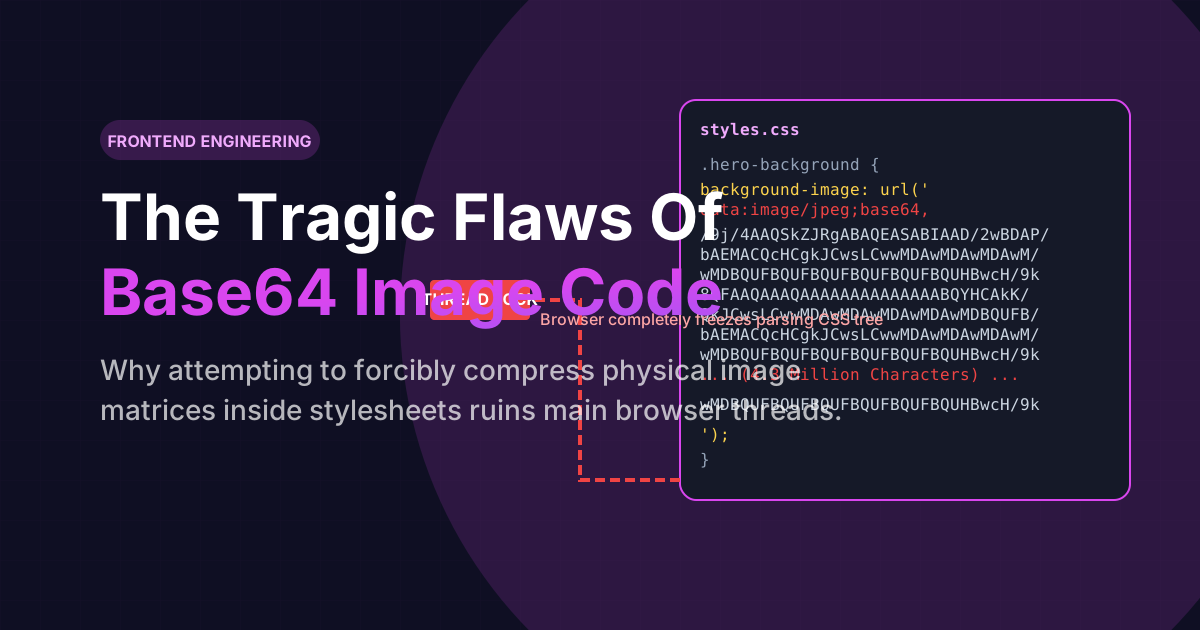
If you execute a raw React or Webpack build sequence, there's a shockingly high chance the compiler natively takes tiny SVG graphics or PNG loading spinners and physically converts them into agonizingly massive Base64 Data URI strings permanently welded straight into your output JavaScript and CSS payload bundles.
Junior engineering circles incorrectly assume this is fundamentally brilliant optimization because it structurally eliminates an extra image server HTTP ping. In reality, aggressively embracing Data URIs physically crashes browser parsing engines.
The Legacy Theory of HTTP/1 Requests
A decade ago, the HTTP/1.1 protocol strictly forced browsers to open sequentially massive, totally separate TCP handshakes for every individual tiny image asset on the site. If you had 40 tiny social media icon images, the site completely stalled out under connection limits.
Developers logically combated this by translating the graphics into Base64 alphabetical characters (`data:image/png;base64,iVBORw0KGgo...`) and forcefully pasting millions of characters entirely inside the `.html` document to bypass the network request entirely.
Parse Legacy Base64 Embedded Blocks
Do you possess a deeply corrupted stylesheet overloaded with encrypted visual matrices? Physically unpack and dynamically reconstruct raw Base64 data strings backwards into optical graphics utilizing our engine.
Launch Native Base64 Decoder SDKThe 33% Mathematical Payload Bloat
The fatal architectural flaw is that Base64 encoding literally utilizes 4 text characters natively strictly to mathematically describe 3 standard data bytes. Meaning intentionally converting an optimized 100KB `.png` image into a Base64 string organically violently inflates the strict filesize up to completely unoptimized 133KB of pure text.
Worse, this gargantuan bloated string actively completely blocks the main browser parsing thread. The browser physically cannot render the underlying DOM text correctly until it meticulously calculates and interprets millions of dense base64 string characters actively blocking the main loop.
Destroying Browser Caching Physics
Standard architectural image assets (`logo.jpg`) actively cache themselves magnificently on the user's hard drive identically forever. If you brutally embed that logo directly inside `app-styles.css`, every single time you push a microscopic tiny 1-line code fix to your CSS, you fundamentally force the user's mobile device to completely intensely manually re-download the massive image array all over again because it was permanently welded to the CSS file.
Frequently Asked Questions
Not at all. For microscopically tiny layout assets strictly specifically under 2 Kilobytes explicitly (like a tiny magnifying glass SVG strictly required instantly before paint), the incredibly tiny string length completely mathematically justifies instantly dodging the network ping.
Yes. The majestic HTTP/2 architectural TCP Multiplexing protocol inherently streams perfectly unlimited parallel graphic requests violently fast down one single pipeline precisely. The entire underlying fundamental excuse for CSS Sprite Sheets or Base64 explicitly completely collapsed globally.
You explicitly enter the `url-loader` or `asset/inline` deeply nested rule arrays specifically and strictly aggressively lower the byte mapping `limit:` size aggressively down towards exceptionally low margins like strictly `4000` bytes absolute.