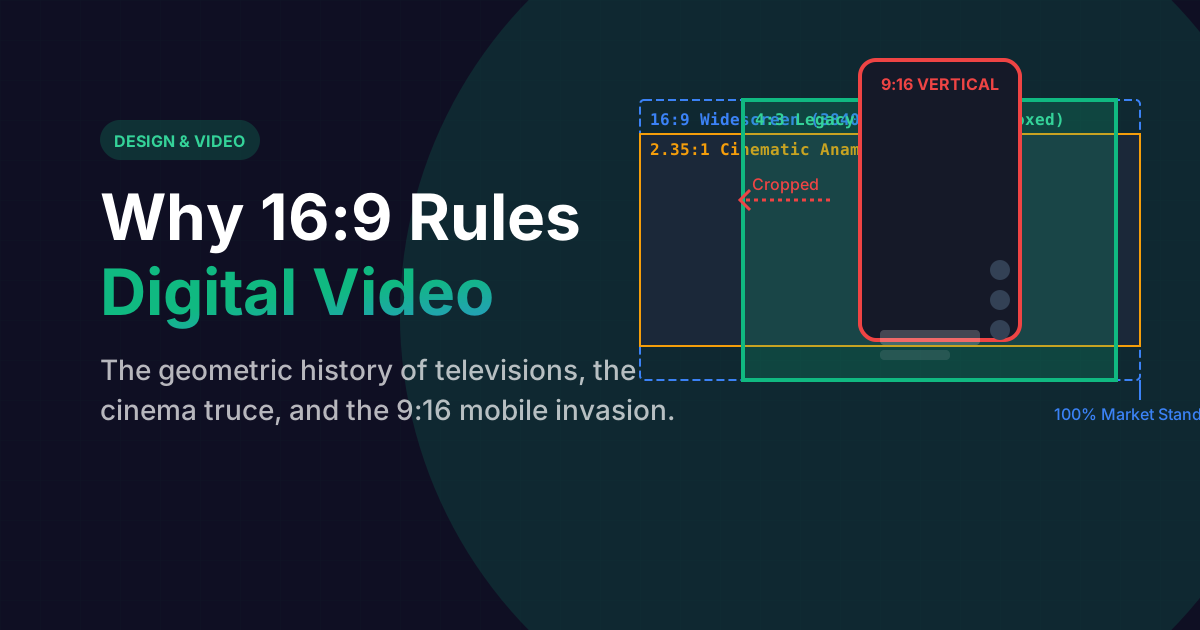
Every flat-screen television sold today, every monitor strapped to an office desk, and every YouTube video embedded on a blog perfectly matches the same invisible geometric boundaries: The 16:9 Aspect Ratio.
This layout format was not decreed by physics. The human eye has an extremely wide panoramic arc, and film directors throughout the 1900s brutally fought over the aesthetic shape of the cinema canvas. The victory of 16:9 is a story of a pure mathematical truce brokered by a single engineer to stop a format war.
The 4:3 CRT Television Monopoly
During the entire 20th century, televisions were perfectly locked into the somewhat square `4:3` (1.33:1) ratio. This was dictated largely by the physical manufacturing constraints of giant glass cathode-ray vacuum tubes.
Movie theaters, terrified that televisions would steal their ticket buyers, explicitly pushed their film aspect ratios to extreme widescreen formats like `2.35:1`. A movie theater offered an incredibly wide, massive panoramic sweep that a tiny box CRT television literally could not replicate. When you attempted to play a widescreen movie on a square TV, you suffered massive black "Letterbox" bars on the top and bottom of the screen.
The Mathematical Compromise
In the late 1980s, the world sought to establish a single global standard for the new "High Definition" broadcast transmission. Dr. Kerns Powers mathematically analyzed the two extremes of the format war: the boxy `4:3` and the extreme cinematic `2.35:1`.
He drew them on top of each other, calculated the geometric mean proportion, and discovered a perfect mathematical middle ground: 1.77:1 (which simplifies precisely to fractions of 16:9). It was the ultimate compromise. It allowed regular TV broadcasts and extreme cinema cuts to both play on the same physical screen with the absolute minimum amount of black letterboxing required for both.
Stop breaking your UI graphics
If you try to stretch a 4:3 background layout into a 16:9 container, your graphics will blur, stretch, and horribly pixelate. Use our precise mathematical calculator to instantly scale your pixel resolutions across perfect aspect constraints.
Launch Aspect Ratio CalculatorPushing into 1080p and 4K
Because the industry universally adopted the `16:9` ratio, computational hardware locked into predictable rendering pixel grids. `1920x1080` (1080p) perfectly respects the fraction. When the industry aggressively upgraded display visual clarity, they merely mathematically tiled the numbers up to `3840x2160` (4K UHD). The rectangular box never changed, the pixel density merely quadrupled.
The Violent Rise of 9:16 Vertical
However, the absolute dominance of horizontal `16:9` is currently under catastrophic siege. The mobile phone is actively constructed to be held with one hand. When TikTok aggressively locked their architecture to forcing full-screen `9:16` vertical video playback, they permanently shattered the horizontal monopoly. Marketers today must shoot duplicate content: horizontal for YouTube infrastructure, and vertical for the infinite algorithmic doomscroll.
Frequently Asked Questions
16:10 is an alternative standard heavily pushed by Apple (in MacBooks) and office monitor lines. It is slightly taller than standard 16:9 video formats, intentionally providing extra vertical screen real-estate which severely aids in scrolling long text documents and writing code layouts.
Because elite cinema directors (like Christopher Nolan or Denis Villeneuve) absolutely refuse to crop their visual intent. They shoot in massive IMAX or extreme Anamorphic Widescreen (producing a 2.39:1 aspect ratio). Because their artistic rectangle is physically wider than your 16:9 television, the screen must pad the top and bottom with blank pitch-black pixels to make it fit.
It acts precisely like cross-multiplication. If you have a locked 16:9 ratio and you mandate a width of `800` pixels mathematically you divide 800 by 16 (equals 50), then multiply by 9 (equals 450). Your exact required height is `450` pixels to prevent stretching.