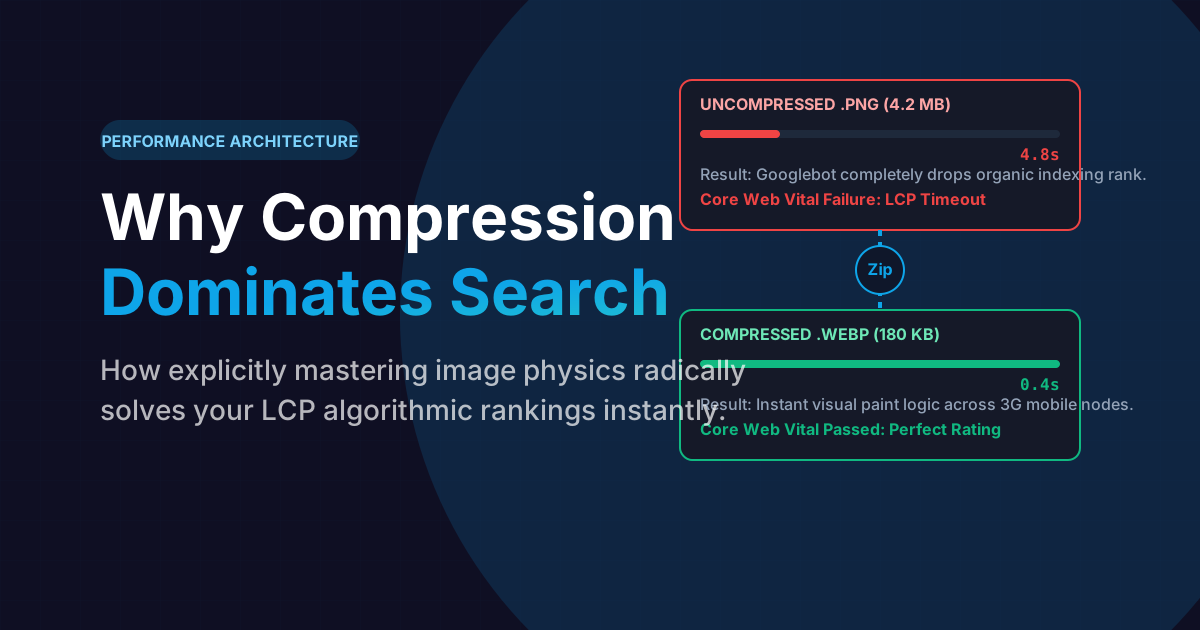
You can meticulously hand-craft the most elegant React `.jsx` code available, completely minimize your CSS bundles, and execute flawless server-side database querying. However, if your marketing team explicitly uploads a raw, 4-Megabyte DSLR cover photograph directly into the webpage `.hero` container, your Google Search rankings will violently plummet.
Modern algorithmic ranking literally revolves around a strict mathematical paradigm known as Core Web Vitals, and the single most terrifying metric in that array is entirely dictated by uncompressed image blockades.
The Largest Contentful Paint (LCP) Constraint
Google mathematically measures how incredibly fast the single largest visual element above the user's viewport folding line physically renders. This metric is explicitly defined as Largest Contentful Paint (LCP), and Google enforces a draconian hard limit: It must load in entirely under 2.5 seconds.
Because the LCP is almost always your massive article Hero Graphic or E-commerce product photograph, a massive uncompressed 4MB `.png` payload attempting to squeeze through a slow 3G mobile network cell tower fundamentally takes 8 literal seconds to render, definitively failing the Core Web Vital audit instantly.
Instant Mathematical Compression
Do not accidentally launch massive RAW image matrices into production CDNs. Explicitly crush your byte payload sizes down to micro-fractions using our dedicated lossless compression pipeline tool.
Launch Native Image Compressor EngineLossless vs Lossy Mathematics
Developers routinely misunderstand the physical mathematics behind byte crushing algorithms. Lossless compression actively strips entirely invisible metadata (camera EXIF coordinates, color profiles) without throwing away a single visual coordinate pixel. It guarantees perfection but only saves around 15% of the data width.
Lossy Compression is what actually saves web infrastructure. The algorithm specifically recognizes that the human optical nerve literally cannot distinguish between `rgb(20,20,20)` and `rgb(21,21,20)` inside shadow gradients. It systematically deletes millions of localized micro-pixels, replacing them with larger aggregate mathematical blur blocks. This radically obliterates the file size by 85% with absolutely zero perceivable human quality drop.
WebP and AVIF Superiority
The legacy formatting of `.jpg` and `.png` is brutally obsolete natively. Google explicitly actively forces the web toward the modern `.webp` and `.avif` formats. Because NextGen formats utilize highly complex temporal video-compression mathematical frames rather than standard grid pixels, they systematically achieve the exact same optical sharpness of a `.jpg` at radically half the actual file weight natively.
Frequently Asked Questions
Absolutely not. Lazy-loading explicitly delays the request network ping until the browser natively finishes rendering the overarching DOM string. If you lazy-load the largest LCP node above the fold, you artificially brutally murder your LCP timing score.
Modern elite tiers of Cloudflare precisely do process algorithmic compression on the fly. However, relying on edge delivery requires massive corporate paid tier routing. Manually compressing the raw asset before server upload guarantees permanent architectural performance.
Browsers naturally attempt to natively paint images at their exact physical pixel width. Using `max-width: 100%` logically confines the asset specifically within its parent CSS `div`, natively forcing responsive mobile down-scaling gracefully.