If you copy a block of Japanese text, paste it next to an Arabic formatted sentence, and add a heavy black font emoji at the end, your computer renders the paragraph perfectly without breaking a sweat. Today, we consider this completely normal.
In 1995, attempting this action would have completely destroyed the structural rendering engine of your web browser, outputting lines of horrific unreadable garbage characters (`éå`). The fact that we have a globally synchronized internet is due exclusively to one foundational technology protocol: Unicode.
The Absolute Chaos of ASCII
In the early days of computing, US engineers built the ASCII standard. Memory was incredibly expensive, so they strictly limited text mapping to a 7-bit dataset. This allowed exactly 128 characters total. It perfectly covered the English alphabet, numbers 0-9, and punctuation marks like `@` and `$`.
That was fantastic for California, but a disaster for the rest of the world. As computers expanded globally, foreign nations began building their own independent text encoding standards. If a Russian computer sent an email using the Windows-1251 alphabet mapping over to a French computer running ISO-8859, the French computer's screen would output literal gibberish because the numerical mappings fundamentally clashed.
The Unified Universal Database
The Unicode Consortium was formed to eradicate this localization nightmare. Their objective was staggeringly ambitious: Assign a literal, unchangeable, unique mathematical ID integer (a "Code Point") to absolutely every single written character from every single language in human history.
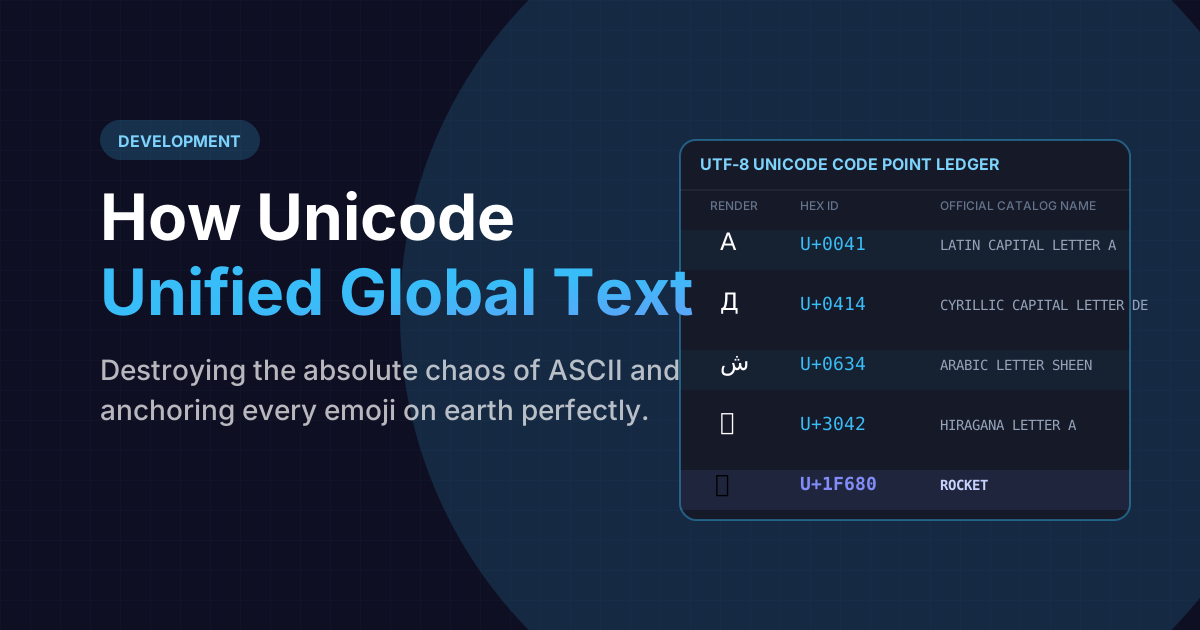
In this system, the letter `A` is permanently tracked as integer `U+0041`. The Greek symbol `Ω` is legally anchored to `U+03A9`. By forcing every operating system on earth (Windows, macOS, iOS, Linux) to agree to this central mathematical ledger, cross-cultural data corruption was permanently annihilated.
Inspect the raw Unicode logic
Do you need to extract the exact hexadecimal Code Point hidden behind a foreign character or complex emoji? Use our dedicated developer tool to algorithmically unmask any text directly into its raw numerical Unicode architecture.
Launch Unicode DecoderWhy Emojis Share the Same Pipeline
Because the Unicode ledger was expanded into a massive 32-bit architectural runway, it holds enough structural space for over 1.1 million distinct characters. We currently only use about 150,000.
This massive empty void of space is why Emojis were able to take over the internet. Emojis are not sent over the network as `.png` image files. When you text a 'thumbs up', you are transmitting perfectly weightless Unicode Code Point `U+1F44D`. When the receiving phone sees that exact number, the local OS looks at its own internal graphics library and draws the thumbnail locally. This is why the exact same emoji looks different on an iPhone versus a Samsung.
Frequently Asked Questions
Unicode is the abstract database catalog of numbers. UTF-8 is the physical file encoding rule that tells the server *how* to save those numbers to a hard drive dynamically, utilizing 1 to 4 bytes depending on how complex the specific character limit is, achieving maximum compression efficiency.
That is the official Unicode "Replacement Character" (`U+FFFD`). If a text rendering engine encounters a chunk of binary data that is corrupted or invalid, it gracefully traps the error by printing the black diamond instead of aggressively crashing the entire software application.
Yes. The Consortium actively indexes Egyptian Hieroglyphs, ancient Cuneiform, and runic alphabets, ensuring academic artifacts are permanently preserved in structured, searchable digital databases.