There is a universally accepted joke amongst backend developers: "The hardest two things in computer science are naming variables, caching invalidation, and off-by-one Timezone bugs."
You launch an e-commerce website. A customer in California buys an item at 10 PM. They expect a receipt that says 10 PM. However, your database server is physically located in a data center in Ohio. The server records the transaction as having occurred tomorrow mathematically at 1 AM. Suddenly, daily revenue reports fracture. Analytics algorithms shatter. It is absolute chaos.
Let's map out the exact engineering strategies to survive global timezone deployments.
The Geographic Programming Trap
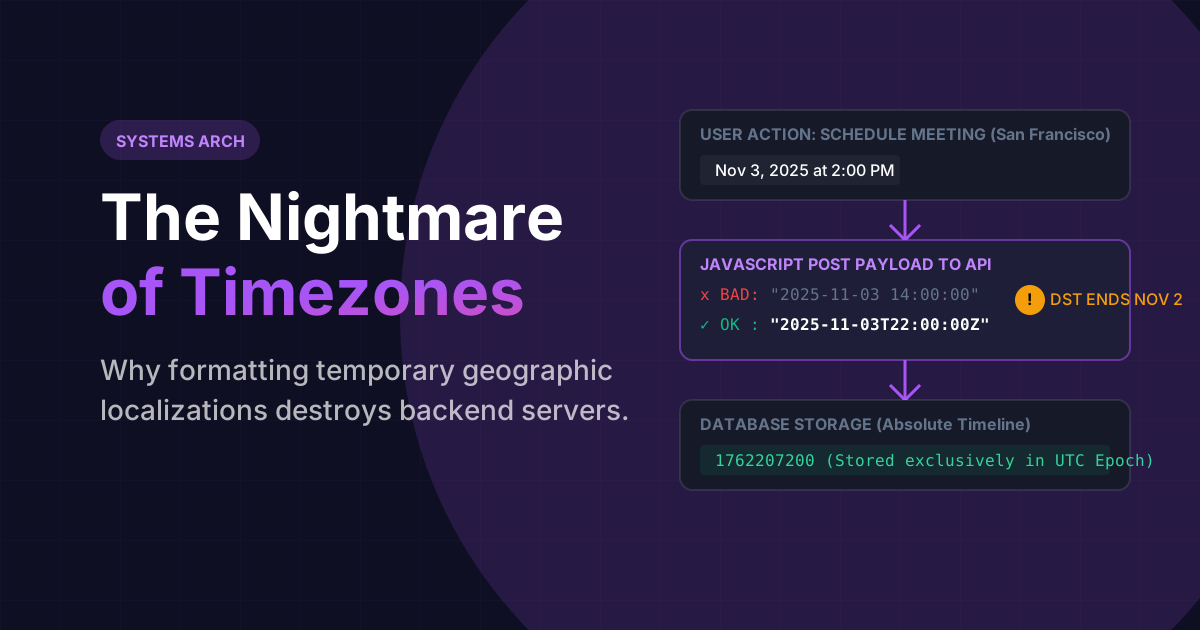
In web mechanics, local time is a pure illusion. If your JavaScript tries to save the string `"2025-06-24 16:30:00"` to a database, you've already failed. Because that string is highly localized, any server fetching it later lacks critical context to perform mathematical offsets.
To perform temporal mathematics, a backend machine explicitly requires an `Offset` appended to the ISO string (e.g., `-08:00`), signaling precisely how far detached that localized event was from the prime meridian. If that metadata is aggressively stripped, chronological operations break horizontally.
Rule 1: Always Store in UTC
There is exactly one immutable law in software engineering regarding timeframes: Zero manipulation inside the database string format. All entries must be brutally anchored to Coordinated Universal Time (UTC).
By enforcing the UTC standard across your entire architectural stack, your database never has to "think" about timezones. A timestamp logged from Beijing aligns geometrically perfectly with a timestamp logged from Texas. The database operates as an absolute, unmoving timeline.
Verify your offset offsets
Do not guess daylight offsets mathematically. Use our global zone processor to calculate the precise hour conversion gaps between massive international cities, preventing catastrophic deployment bugs.
Launch Global Timezone ConverterThe Daylight Saving Time Bug
If fixing timezones was just adding or subtracting a static `+5` hours, the problem wouldn't exist. The true nightmare is Daylight Saving Time (DST). Politicians randomly dictate that on specific Sundays, clocks instantly warp forward or backward.
Furthermore, different countries engage DST on entirely different weeks of the year. Arizona doesn't engage it at all. Adding a strict `+8 hours` offset mathematically fails catastrophically twice a year. Engineers must rely entirely on centralized massive IANA Time Zone databases (like `Intl.DateTimeFormat` or Moment.js) that internally track the chaotic geographical logic rules for every region.
Client-Side Presentation Math
The solution pipeline works exactly like this:
- The Browser generates a timestamp.
- The Browser immediately converts it to `UTC` and fires it via the API.
- The Database logs the `UTC` string.
- When the user loads the page tomorrow, the Database serves the `UTC` string back to the API.
- The Browser receives the `UTC` string, detects the user's local operating system clock settings, and dynamically renders the UI calculation to their current timezone exactly at presentation runtime.
Frequently Asked Questions
It is the international standard mathematical format for securely transmitting dates across API payloads, looking like `2025-06-24T18:30:00.000Z`. The 'T' separates the date from the time. The critical 'Z' (Zulu time) explicitly informs the server that the payload is perfectly normalized to UTC zero-offset.
Absolutely never. Because governments randomly alter geographical timezone borders and DST dates constantly, writing your own logic will silently break. You must utilize massive verified external libraries (like `date-fns-tz` or JavaScript's native implementation) that update their IANA geo-databases dynamically via package managers.
No. If a user's laptop battery dies and resets their system clock, their browser will submit massive localized timestamp errors to your Server. Your backend architecture must always validate submitted payloads against the absolute server-side `Date.now()` constraints to catch timestamp tampering.