If you query a modern backend database and ask it what time it is, it will not natively respond with "Thursday, June 21, 2025." A traditional calendar date is linguistically complex, culturally biased, and practically impossible to mathematically index and sort efficiently.
Instead, the server will hand you a massive integer string that looks exactly like this:
1750464281This single row of numbers silently orchestrates the global digital economy. It is the framework dictating precisely when bank transfers clear, when SSL certificates expire, and when GPS satellites calculate your location. It is known as the Unix Epoch Timestamp.
What is the Unix Epoch?
In the late 1960s, engineers building the very first Unix operating systems realized they needed a singular, universal starting point to calculate time mathematically. They established the "Epoch".
The Unix Epoch is rigidly defined as: January 1st, 1970 at 00:00:00 UTC.
The timestamp you saw above (`1750464281`) is simply the exact tracking count of literal seconds that have elapsed since that specific moment in 1970. No months. No leap years. No language formatting. It operates purely as a massive, constantly incrementing metronome ticker for the digital world.
Eradicating the Timezone Nightmare
A timestamp is the ultimate antidote to the nightmare of server timezones. Because the Unix Epoch is strictly locked to UTC (Coordinated Universal Time), the integer string is globally absolute regardless of physical location.
If a user in Tokyo clicks 'Purchase' at the exact same millisecond that a user in New York clicks 'Purchase', both web browsers will generate the identically identical Unix Timestamp integer. The system only translates that integer back into regional, localized "Human Date Formats" when visually displaying it on a UI screen.
Translate Timestamps Instantly
Looking at raw server logs tracking database transactions in opaque integer formats? Use our precise visualization tool to convert massive Unix Timestamps directly back into human-readable local timezones instantaneously.
Launch Unix Timestamp ConverterThe Year 2038 Problem (Y2K38)
The ingenuity of the Unix Timestamp is about to collide violently with legacy hardware constraints. In the early days of computing, strict memory optimization was mandatory. To save RAM, the Unix clock was originally programmed as a 32-bit signed integer.
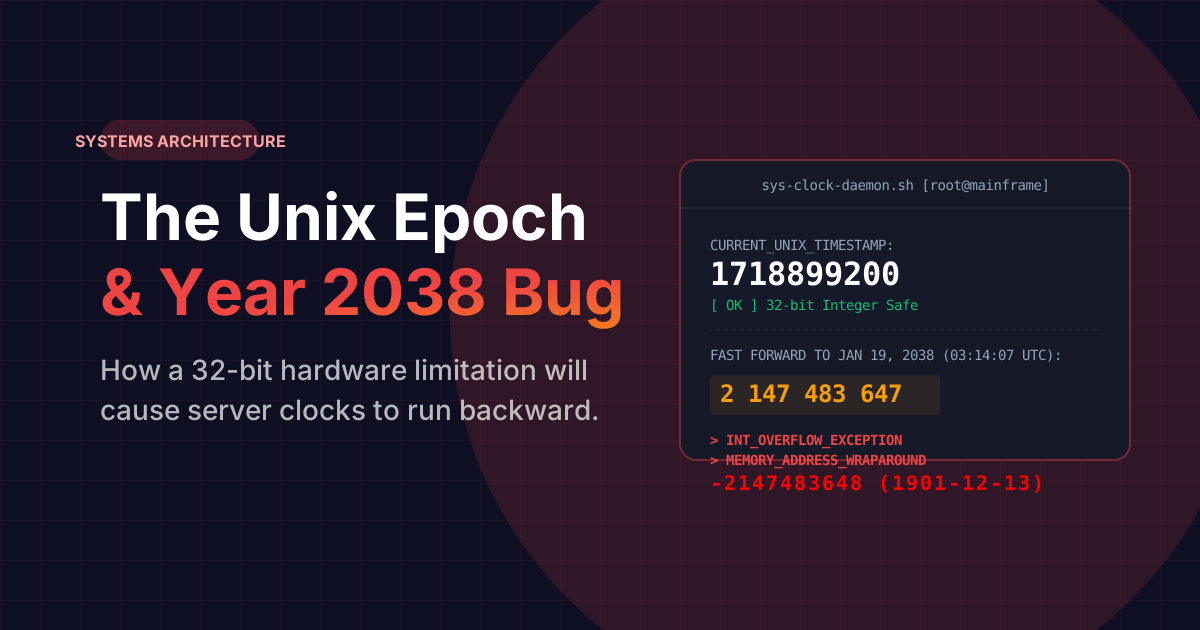
A 32-bit signed integer is a binary format that has a strict mathematical maximum ceiling. The highest possible number it can physically store is exactly 2,147,483,647.
If you take the Unix Epoch starting point (Jan 1, 1970), and add 2,147,483,647 seconds to it, you arrive precisely at January 19, 2038, at 03:14:07 UTC.
On that exact second, the 32-bit integer will overflow. Unable to parse the number "2,147,483,648", the binary bit will flip into the negatives, aggressively resetting the global clock back to December 13, 1901.
The 64-Bit Migration Solution
If unmitigated, 2038 will act identically to the infamous Y2K bug, but drastically more destructive. Entire 32-bit embedded systems handling water treatment plants, legacy bank mainframes, and older Android smartphones would instantly perceive expired security protocols and violently crash.
The industry is actively rushing to migrate all physical servers and operating system kernels to 64-bit architectures. A 64-bit integer pushes the mathematical ceiling so impossibly high that the new timestamp overflow won't occur for roughly 292 billion years, permanently resolving the issue long after the sun burns out.
Frequently Asked Questions
Not exactly. While standard Unix calculates in full Seconds, the JavaScript standard (via `Date.now()`) explicitly tracks time in Milliseconds since the Epoch. If you feed a JS timestamp directly into a PHP backend without division, the server will think the year is roughly 40,000 AD.
Because the original architects utilized a "signed" integer, the system safely operates in reverse. Dates occurring prior to Jan 1, 1970 are simply represented as negative Unix integer strings traversing backward into history.
Yes. Apple fully migrated the iOS architecture to 64-bit processors starting with the iPhone 5s back in 2013. The vulnerability strictly targets legacy servers running old unpatchable Linux distros, archaic ATMs, and 32-bit SCADA industrial control hardware.