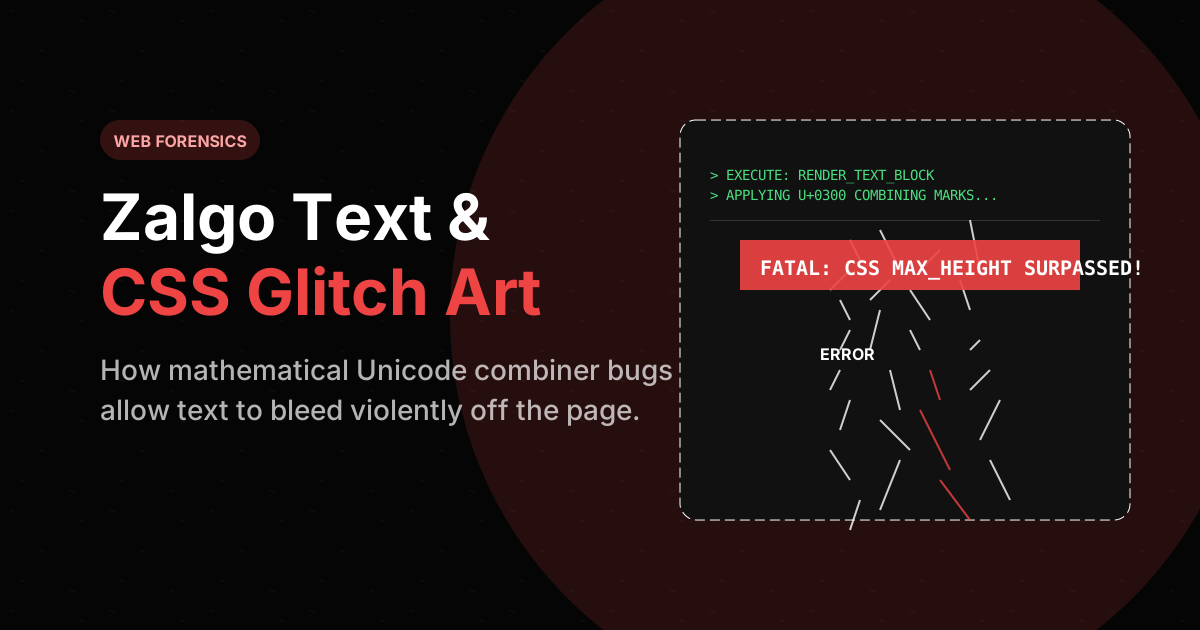
If you've spent significant time inside gaming Discord servers, Reddit threads, or indie game comment sections, you've inevitably encountered a paragraph of text that looks possessed by an eldritch demon. The text refuses to stay inside its boundaries, sending chaotic streaks of black noise pouring violently into the HTML elements above and below it.
It is known ceremonially as H̖eͨ C͎o̺m͊e͔s͇ (Zalgo). It is not a virus. It is a stunningly clever exploitation of the rules that tell your web browser how to draw physical typography.
The Lovecraftian Meme Origins
The term "Zalgo" originates from a 2004 webcomic parodying Garfield, where characters' eyes bleed and they begin praising an unseen, Lovecraftian hive-mind deity. The internet immediately adopted the aesthetic, explicitly looking for ways to visually warp standard web forums to look "corrupted" without actually hacking the server.
The Math of Unicode Combiners
Zalgo works by violently abusing the Unicode Combining Characters specification.
When the Unicode system was built to accommodate global languages, they ran into a problem: The French language uses an `e` with an accent over it (`é`). The Thai language often stacks three or four distinct vowel marks directly onto a single consonant.
Instead of mapping millions of unique pre-combined letters, engineers created a genius mathematical shortcut. You can type a standard `e`, and then immediately type a special, invisible "Combining Accent" character. The text engine instantly merges the two floating graphics, drawing the accent directly on top of the `e`.
Zalgo scripts simply loop this logic. They inject 40 or 50 combining diacritics onto a single letter simultaneously. The rendering engine dutifully attempts to stack them all on top of each other, pushing the ink aggressively higher and higher off the baseline.
Unleash the HTML glitch
Do you want to experimentally break standard structural layouts? Use our generator to inject raw randomized data stacks onto your text base, forcing the text rendering engine to bleed vertically beyond its CSS confines.
Launch Zalgo Text CorruptorWhy the Text Bleeds
Web browsers are built with CSS rules like `overflow: visible;` established by default. Browsers assume that text will naturally fit inside line-height boundaries. When a Zalgo stack pushes graphical ink 200 pixels vertically, it literally overrides the standard Document Object Model (DOM) container rules, overlaying onto neighboring `div` blocks and completely destroying UI readability.
Sanitization and Mitigation Protocols
If you are building an application with user comments, you must actively sanitize incoming Zalgo payloads. Otherwise, a single malicious user can permanently obscure an entire discussion thread.
Backend systems run precise Regular Expression (RegEx) patterns aimed directly at the Unicode Combining Character block (ranges \u0300-\u036F). The script strips out excessive diacritics, flattening the corrupted text back into a sterile, one-dimensional string before it reaches the SQL database.
Frequently Asked Questions
Not inherently. Zalgo is strictly a graphical rendering issue, not executable code. However, pasting massive Zalgo payloads into older Command Prompts can completely jam the character buffer, causing the console UI to temporarily freeze while attempting to calculate the astronomical ink paths.
This is a massive accessibility disaster. A severe Zalgo payload will force an audio screen reader to attempt to sequentially pronounce 30 different invisible tonal shifts per letter. It sounds like pure robotic stuttering static, breaking the platform for visually impaired users.
Mathematically, no. But practically, modern web browsers like Chrome and Firefox have actively hard-coded graphic limiters to truncate the display height at around 1.5x line-height to prevent total crash conditions.