When most people sit down with a real estate agent to purchase a $400,000 home, they only ask one question: "What will my monthly payment be?"
This is exactly the question the banking industry wants you to ask. By hyper-focusing your attention on a comfortable recurring monthly number, you become entirely blind to the catastrophic exponential calculus operating underneath the surface of your loan.
The 30-year fixed-rate mortgage is a marvel of financial engineering designed to maximize bank profits through front-loaded interest mapping. In this guide, we are going to expose exactly how mortgage math works, and how changing your loan duration from 30 years to 15 years fundamentally alters the trajectory of your wealth.
The Illusion of the Monthly Payment
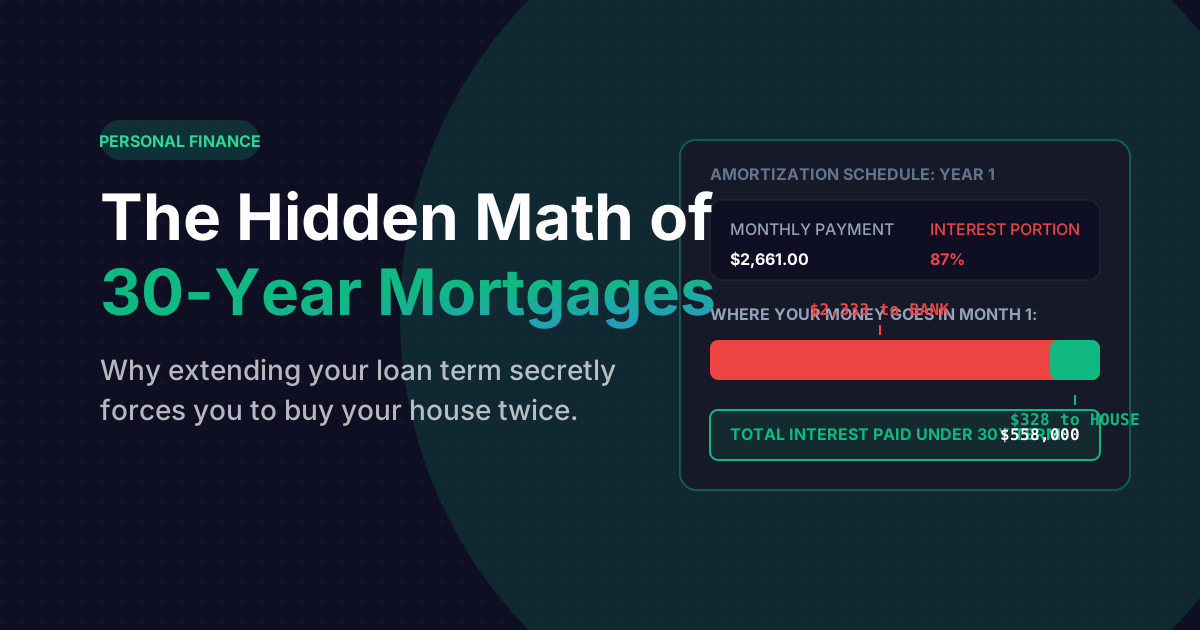
Let's assume you borrow exactly $400,000 at a 7% interest rate on a 30-year fixed term. Your estimated principal and interest payment is $2,661 a month.
If you take that exact same scenario and switch it to a 15-year term, your monthly payment jumps to $3,595.
To the untrained eye, the 15-year mortgage looks like a terrible deal. Why would anyone willingly increase their monthly housing burden by nearly $1,000 just to pay the house off sooner? The answer lies in a banking mechanism known as the Amortization Schedule.
Stop guessing your numbers
Run your exact loan parameters instantly. Compare 15-year vs 30-year terms, total interest paid, and see the brutal efficiency of mortgage mathematics using our specialized tool.
Launch Mortgage CalculatorWhat is an Amortization Schedule?
Your identical monthly payment of $2,661 does not magically pay down your house equally for 30 years. Banks utilize amortization to front-load the interest.
In month one of your 30-year mortgage, the bank immediately extracts their 7% cut based on the massive total balance of $400,000. Out of your $2,661 payment, an astronomical $2,333 goes directly to the bank as interest profit. Only a meager $328 actually touches the principal owed on the house.
For the first 15 years of a 30-year loan, you are essentially renting the money from the bank. You are drastically over-paying interest while your physical ownership in the property barely moves an inch.
How 30 Years Forces You To Buy the House Twice
If you take that $400,000 loan at 7% and stretch it across 360 monthly payments (30 years), the total interest you surrender to the bank reaches roughly $558,000.
Read that carefully. You bought a $400k house, but you ended up paying over $950,000 total. You literally bought the house twice, and handed the second house directly to the CEO of a financial institution.
If you swallow the higher monthly premium of the 15-year mortgage ($3,595), the total interest surrended plummets to $247,000. By suffering slightly higher monthly anxiety, you instantly vaporize $300,000 in bank fees.
The "One Extra Payment" Hack
If you are already locked into a 30-year mortgage and cannot afford the massive leap to a 15-year refinance, there is a mathematical loophole. You can manually attack the principal.
By making just one single extra mortgage payment per year, explicitly dedicated to the 'Principal Balance', you aggressively skip forward in the amortization schedule. Because future interest is calculated solely on remaining principal, reducing it early destroys compounding interest pipelines.
Making just one extra payment a year reduces a standard 30-year loan down to roughly 24 years, saving you tens of thousands of dollars in the process.
Frequently Asked Questions
Private Mortgage Insurance (PMI) is a literal junk fee enforced uniformly by lenders if you put down less than 20% equity. It protects the bank, absolutely not you. Unless you are intentionally leveraging cash for highly profitable external investments, bringing 20% down avoids throwing away $150+ a month on phantom insurance policies.
ARMs offer a teaser artificially low rate for the first 5 to 7 years. They are historically incredibly dangerous for civilian homeowners because eventually, the rate "adjusts" to the volatile market. The only logical scenario for an ARM is if you have absolute, legally binding certainty that you will sell the home before the introductory rate expires.
No. Pouring $40,000 into a luxury bathroom remodel almost never increases your appraisal exactly $40k. Usually, cosmetic renovations recover roughly 50% to 70% of their cost in equity gains. Structural square footage additions or fixing broken systems (roofs) historically offer the best Return on Investment.