When you open an app to check how many Euros you will get for your US Dollars, a number instantly materializes on the screen. It feels authoritative. But the frightening reality of the foreign exchange (Forex) market is that there is absolutely no central global clearinghouse that dictates currency values.
Unlike the New York Stock Exchange, which tracks strict, singular ledger trades for a single company, Forex is an aggressively decentralized network of thousands of independent banks blindly screaming quotes at each other over fiber optic cables. Let's explore how web applications tame this chaotic data via structural API pipelines.
The Illusion of "The Price"
Because there is no centralized ledger, the price of USD vs JPY (Japanese Yen) technically varies by micro-cents depending entirely on which two banks are performing the ledger settlement. Deutsche Bank might hold a slightly different liquidity quote than Barclays.
When you see a specific exchange rate on a web tool, you are not seeing "The" absolute price. You are seeing an aggregated midpoint average calculated from a massive swarm of top-tier institutional market makers (Tier-1 banks).
The Central API Aggregators
Companies cannot wire millions of servers directly into bank mainframes for real-time pinging. The infrastructure cost would result in immediate corporate bankruptcy.
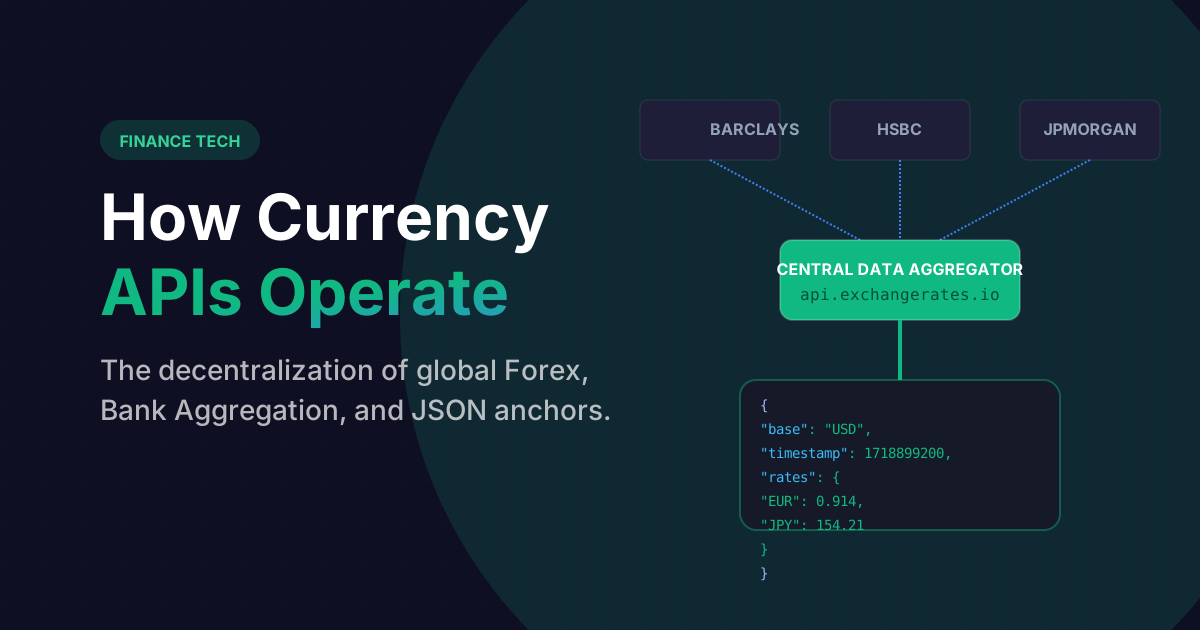
Instead, massive data brokers (like Reuters or Bloomberg) purchase the proprietary direct data-hoses from the banks, average out the noise algorithmically, and distribute the clean, mathematical mid-point via HTTP REST APIs to software developers across the globe. When a developer builds a currency converter, they are executing a strict `.fetch()` request asking the central broker node for the 3 PM snapshot vector.
Calculate conversions securely
Do not guess the localized banking spreads. Tap directly into real-time synchronization pipelines. Quickly map US Dollars to Euros, Rupee, Yen, and 160+ fiat structures natively through our interface.
Launch Global Currency ConverterBase Anchoring and JSON Distribution
Providing the exchange rate for every combination of 160 global currencies dynamically would require transferring massive, mathematically dense payload structures every 3 seconds. To prevent API crashing, brokers utilize the "Base Anchor" paradigm.
APIs will generally push down a singular, lightweight JSON file tracking exactly 160 values all uniformly mapped against exactly ONE currency (usually the USD). If a software application needs to convert Mexican Pesos into Canadian Dollars, it does not query the API for a specific MXN-to-CAD endpoint. It pulls the USD anchor array, and mathematically executes a cross-rate division locally inside the client's browser.
Frequently Asked Questions
Google displays the true 'mid-market' rate—the mathematical halfway point between global institutional buy and sell orders. When you walk into your commercial bank, they aggressively apply a retail markup spread. You are paying a hidden premium fee to swap physical paper or retail server accounts.
No. The massive institutional decentralized Forex market definitively pauses trading at 5:00 PM EST on Fridays and remains frozen until 5:00 PM EST on Sundays, locking all API endpoint values into a static cache block over the weekend.
Yes. Institutional trading dashboards utilize ultra-expensive persistent WebSocket connections to stream sub-second tick changes. Standard web converter tools use REST API endpoints and aggressively cache the response for 1 to 24 hours to preserve operational bandwidth, as general consumers do not require micro-second accuracy.