You are sitting in a meeting. Your boss looks up from a spreadsheet and asks, "Traffic increased from 1,450 to 1,920 this month. What's the percentage increase?"
If your heart immediately drops into your stomach, you are not alone. Despite fractions and percentages being taught in elementary school, they are universally cited as one of the most frustrating, anxiety-inducing parts of adult business life. The equations mysteriously flip, standard calculator apps are confusing, and getting it wrong can cost you massive amounts of money.
In this guide, we are going to completely demystify business percentages. No complex textbook jargon—just human-friendly logic to help you master percent increases, margins, and the secrets of the calculator.
The "Mental Block" Against Percentages
The origin of the word Percent literally means "per hundred" in Latin. It is simply a ratio. Instead of saying "14 out of every 50 people clicked the link," we standardize it to a base of 100 to make it comparable. 14 out of 50 equals 28 out of 100. Thus: 28%.
The mental block happens because when we speak in conversation, we omit the underlying equation. We say "Calculate a 15% tip," but what we are actually asking the brain to do is "Take the total, multiply it by 15, and divide by 100."
The Golden Secret: Percentages are Reversible
Here is a mathematical trick that will blow your mind and save you hours of mental gymnastics: Percentages are universally reversible.
X percent of Y is exactly the same as Y percent of X.
Imagine you need to quickly calculate 4% of 75 in your head. That sounds difficult. But reverse it: What is 75% of 4? Well, 75% is just three-quarters. Three-quarters of 4 is 3. Therefore, 4% of 75 is also 3.
Next time you are stuck trying to calculate 18% of 50, flip it. 50% of 18 is 9. You just simulated a calculator instantly in your head.
Calculating Growth: Percent Increase & Decrease
This is the most common corporate metric. Whether you are tracking website traffic, quarterly sales, or stock portfolios, you need to know how to calculate growth.
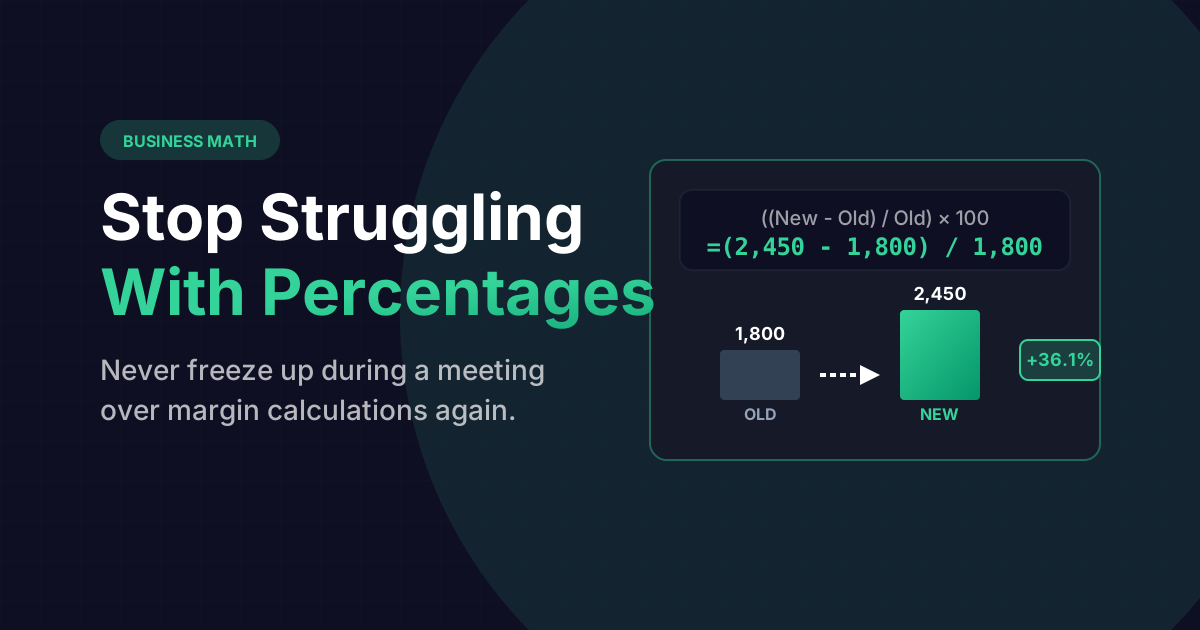
The universal formula for Percentage Change is always:
Example: Sales were $500 last month (Old) and $650 this month (New). What is the increase?
- Step 1: Difference = $650 - $500 = $150
- Step 2: Divide by Old = 150 / 500 = 0.3
- Step 3: Multiply by 100 = 30% Increase
Stop wrestling with formulas
Eliminate manual math errors entirely. Just input your plain-English numbers into our web tool and instantly get exact percentage variations.
Launch Percentage CalculatorWhy "Markup" is not "Margin"
Thousands of small businesses go bankrupt because they fail to understand the difference between Markup and Margin. This is a critical percentage trap.
If you buy a widget for $100 and want a "50% profit margin," you might think you simply add 50% to the cost and sell it for $150.
That is incorrect. That is a 50% Markup, but it only results in a ~33% Profit Margin.
- Markup is the percentage of the cost added to reach the selling price. (Profit / Cost)
- Margin is the percentage of the selling price that is profit. (Profit / Sales Price)
If you sell the widget for $150, your profit is $50. Since Margin is Profit divided by Selling Price ($50 / $150), your margin is 33.3%.
The Modern Solution: Automating the Equation
Unless you are taking a standardized math test, there is no reason to risk a $15,000 corporate error by trying to hold standard deviation math in your working memory.
Using a dedicated web utility like the Footprint Percentage Calculator provides you with intuitive, natural-language fields. Instead of inputting algebraic symbols, you simply type "What is [18]% of [350]?" or "If something increased from [140] to [210], what is the change?". The script dynamically executes the 6-step calculation accurately before you even press a button.
Frequently Asked Questions
Yes. If you have 10 apples, a 100% increase means you add 100% *of the original amount* to it. Thus, you add 10 apples, making it 20. A 200% increase would mean tripling the original amount.
Because the baseline changes. If a $100 stock drops 50%, it relies at $50. Now it must rise 50% from that new baseline. 50% of $50 is $25. The stock rises to $75. To recover from a massive drop, the percentage increase must be exponentially higher than the percentage decrease.
Instead of calculating the 20% discount and subtracting it, simply multiply the original price by the remaining percentage (0.80). A $40 item with 20% off: $40 x 0.8 = $32. You arrive at the final number in one step.