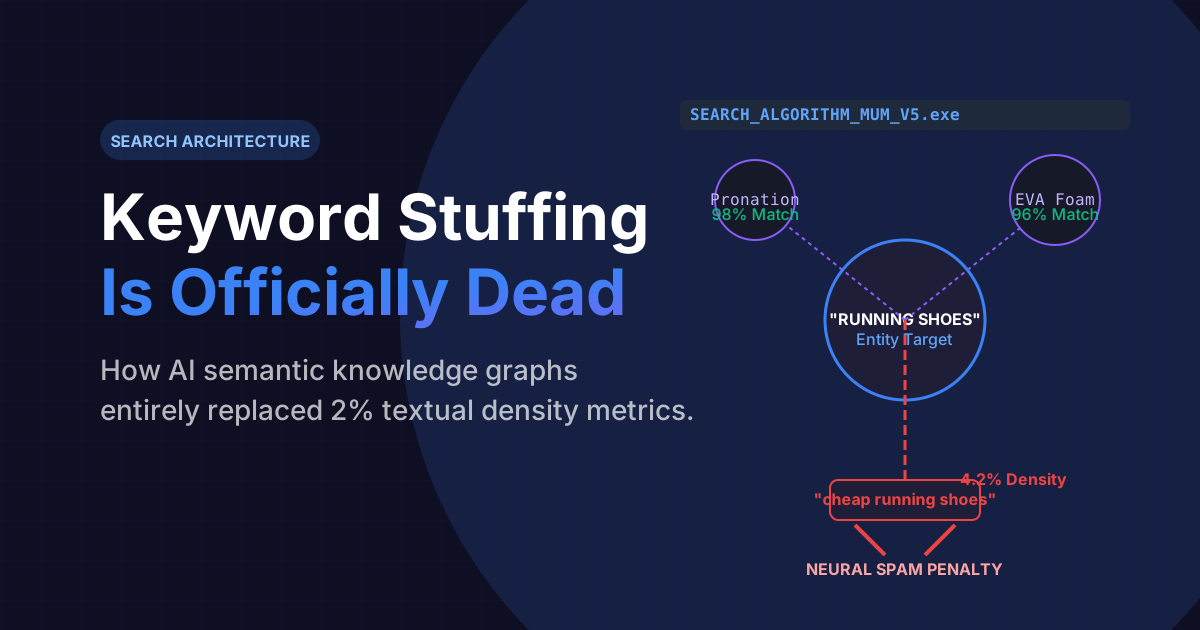
In the early 2010s, Search Engine Optimization was astonishingly mechanical. If you wanted to rank position #1 for "Cheap Car Insurance", you physically injected that exact string phrase precisely 34 times across a 1,000-word article to hit the mathematical "2.5% density ratio." Search engine scrapers were inherently dumb text-matchers.
Today, Google's core algorithm is entirely driven by immensely complex trillion-parameter deep learning Neural Networks (like MUM and RankBrain). Treating modern Google like a 2012 text-matcher will categorically obliterate your domain traffic.
The Myth of the 2% Golden SEO Ratio
Legions of outdated SEO marketing blogs still vehemently argue that your primary keyword must rigorously sit between 1% and 2% textual density. In reality, modern search engines possess zero hardcoded mathematical density requirements. The algorithm does not count words; it fundamentally maps topical authority.
In fact, rigidly adhering to a 2% metric frequently forces human writers to structure sentences awkwardly (e.g. "If you need cheap car insurance, our cheap car insurance professionals are here..."). Modern natural language processors instantaneously flag this forced robotic repetition as explicit spam.
The Rise of Semantic Knowledge Graphs
When you query Google for "Steve Jobs' Company", Google does not physically grep the internet searching for websites that contain the literal word string "Steve Jobs' Company". The AI structurally understands the semantic knowledge graph connecting the entity "Steve Jobs" directly to the corporate entity "Apple". The search engine entirely bypasses exact text-matching and delivers articles written exclusively about Apple.
Scan Your Architecture for Keyword Spam
Do not accidentally trigger an algorithmic spam penalty by over-saturating your DOM. Run your article text through our physical density matrix to violently verify you aren't unconsciously repeating exact match keyword loops.
Launch Live Keyword Density ScannerWhy LSI Topic Mapping Replaced Repetition
In the Neural Network era, you optimize for Latent Semantic Indexing (LSI). Instead of typing "running shoes" thirty times, you prove you are an authority on running shoes by naturally mentioning deeply technical, semantically related vector keywords like: pronation, EVA foam midsoles, heel-drop ratio, asphalt grip, marathon pacing.
The neural network scans your article, recognizes these incredibly complex industry sub-terms, and mathematically concludes your article is a masterclass in athletic footwear, rocketing you to the top of the SERP without ever explicitly keyword stuffing the primary target query.
Frequently Asked Questions
Not entirely. Scanners are fantastic at identifying negative vectors. While there is no "perfect" percentage, passing the 4% density boundary mathematically alerts you that your writer is intentionally over-stuffing text, which will definitively trigger an AI penalty.
Google's AI Overviews literally read, summarize, and conceptually analyze the structural depth of your page perfectly. This completely invalidates "thin content" strategies. If your page doesn't offer massive, unique data sets outside the standard Wikipedia model, the bot won't rank you.
Yes. The algorithm heavily weighs architectural DOM layout hierarchies (H1 -> H2 -> H3) specifically to understand what broad contextual pillar your article focuses on. Utilizing semantic LSI variants inside header tags remains a highly legitimate structural strategy.