Imagine reading a paragraph containing the number `95`. Is the writer referring to the year 1995? A local highway Interstate 95? A product price of $95? Or exactly 95 minutes of cooking time for a recipe?
A human effortlessly concludes the context by viewing the photograph next to the text. A search engine indexing bot sees absolutely nothing but a terrifying void of algorithmic ambiguity. To fundamentally bypass this chaotic guess-work, top-tier engineering teams dynamically bind Schema Markup (JSON-LD) arrays into the backend document structure.
The Catastrophe of Ambiguity
If you run a colossal e-commerce storefront, you inherently possess thousands of active products containing strict mathematical database metrics (Price, Stock Status, Review Stars). If you rely blindly on HTML tags (like `$45.00`) to indicate value, you force Google to write unstable Regex scraping scripts to randomly guess where your price variables live.
When the guessing algorithm inevitably fails, your incredibly critical "In Stock" layout gets actively stripped entirely from the Search Engine Results Page (SERP).
Generate Raw JSON-LD Schema Arrays
Do not attempt to write extremely strict multidimensional JSON hierarchies from memory. Instantly map your entity data (Recipes, Articles, Jobs) directly through our dedicated compilation UI.
Launch Global Schema Compiler ToolThe JSON-LD Architecture Array
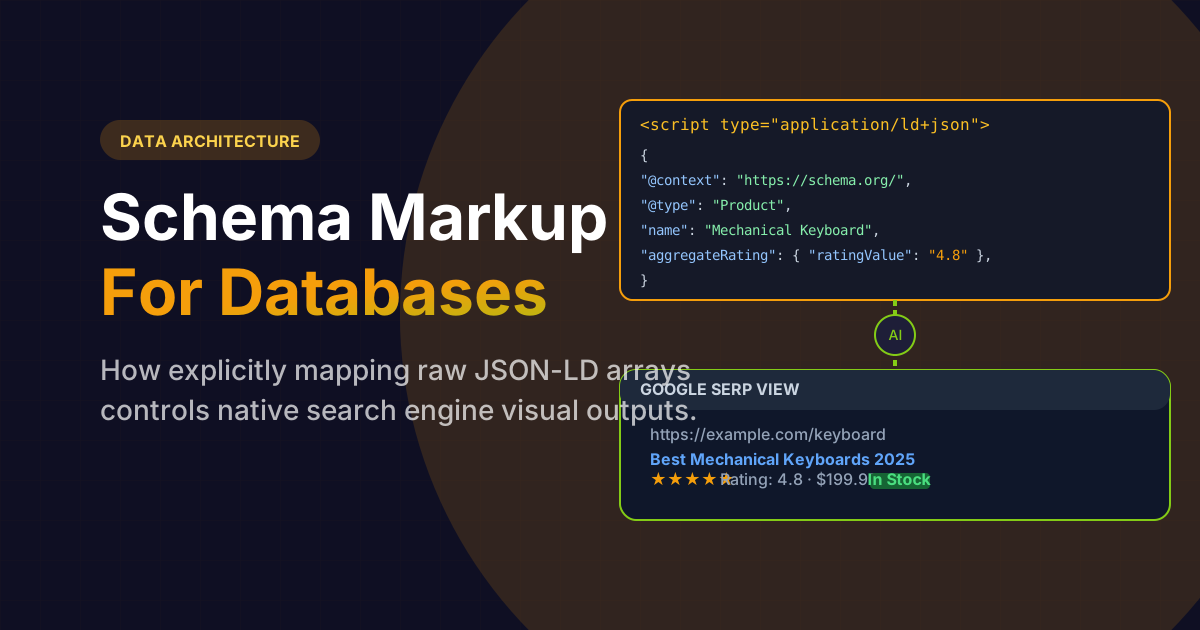
In 2011, the largest global search engines explicitly banded corporately together to establish Schema.org. They mathematically standardized a universal semantic vocabulary. Instead of formatting HTML UI elements, developers natively inject an invisible block of `
This fundamentally bypasses the entire frontend rendering pipeline. You literally hand the raw backend JSON associative arrays (`"price": 45.00`, `"availability": "InStock"`) directly to Google's server logic processor over the protocol connection.
Commanding the SERP Rich Snippet
When Google mathematically matches your JSON-LD array to their internal index, they reward your site heavily by graphically altering your SERP display. Instead of a boring blue link, your exact domain magically renders gold review stars, massive HD image thumbnails, pricing badges, and exact Q&A accordion layouts natively before the user ever even actively clicks the button.
Frequently Asked Questions
Yes. If you maliciously or mistakenly claim an object is `"ratingValue": 5` locally in the JSON array, but the physical HTML page displays exactly zero review UI components to the user, the algorithmic crawler flags a "Structured Data Discrepancy" and punishes the ranking.
Yes. The archaic method of wrapping HTML nodes inside `itemprop="name"` physics natively breaks frontend UI rendering when nested deeply. JSON-LD explicitly rips the database logic entirely away from visual HTML layouts, mapping infinitely cleaner matrices.
Literally everything. From complex nested corporate hierarchies (`LocalBusiness`), detailed architectural building models, highly calculated cooking `Recipe` instructions, heavily scheduled localized `Event` matrices, up to granular `JobPosting` salary arrays.