Building an enterprise web asset takes months. You configure the server, perfect the CSS layouts, tightly optimize the database relationships, and write thousands of words of high-quality organic content.
And then, because you launched in a rush, you forget to bind a tiny $`16x16` pixel icon to your root domain. Suddenly, your search rankings visibly drop, your bounce rates spike, and users struggle to intuitively trust your brand aesthetic. The Favicon is arguably the highest-leverage graphic sitting on the entire internet.
What is a Favicon?
Favicon is short for "Favorite Icon." It was originally introduced back in 1999 natively by Internet Explorer 5. The strict initial intent was to simply add a visual brand marker next to a URL when a user added the link to their local "Favorites" menu inside the browser.
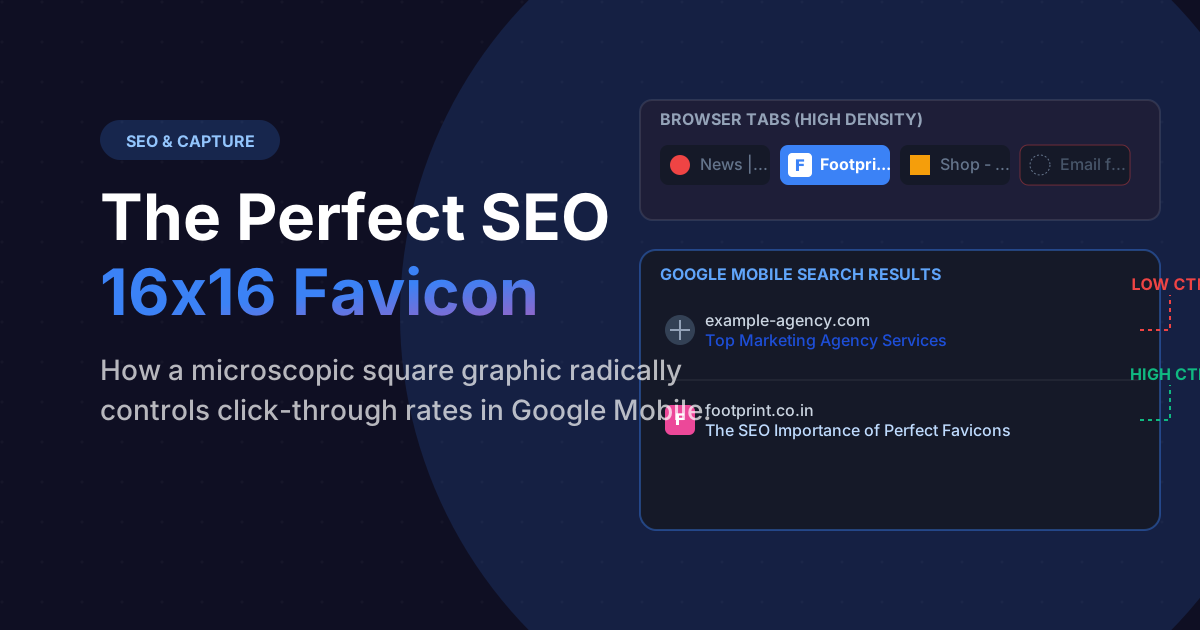
Over time, user behavior exploded into "tab-hoarding." When a user opens 20 browser tabs, the actual page `<title>` text aggressively shrinks and disappears entirely. At that density, the single microscopic 16-pixel square icon is literally the only graphical tether allowing the user to remember where they parked your website.
The Mobile Google Results Overhaul
Historically, favicons were just cute branding. But recently, Google radically overhauled its mobile Search Engine Results Page (SERP) layout. They stopped pushing pure blue links and began natively injecting your site's Favicon physically next to your title tag directly in Google output results.
If you fail to provide an icon, Google punishes your visual real-estate by stubbornly attaching a generic, ugly wireframe globe icon directly next to your brand. In a search wall comprised of dense competitors with vibrant, customized red and blue logos, an empty gray globe radiates amateurism.
Format perfect icons instantly
Do not guess exactly which iOS and Android icon resolutions Apple and Google require to strictly pass validation. Upload your massive source PNG and let our dedicated compiler slice, compress, and output every single required dimensional format natively.
Launch Universal Favicon GeneratorPsychological Impact on Click-Through Rates
SEO tracking structures prove definitively that Click-Through Rate (CTR) is a massive behavioral ranking signal. If you rank #4 on Google, but a user sees your bright orange vibrant favicon and instinctually clicks your link instead of #1, Google's algorithm tracks this. If it happens consistently, Google forcefully pushes you up the rankings.
The favicon is literally an ad banner. The best favicons use a violently high-contrast simple shape (like the GitHub Cat or the orange Y-Combinator square). Extremely complex text logos turn into indistinguishable muddy gray blurs when violently squashed down to 16 pixels.
Frequently Asked Questions
Not entirely, but it is heavily antiquated. Modern web development standardizes heavily on feeding high quality `.png` or strictly mathematical `.svg` vectors, falling back to a `favicon.ico` sitting silently in the root folder strictly for legacy system compatibilities.
If an iOS user decides to "Save your website to the Home Screen", their iPhone automatically looks specifically for an invisible HTML meta tag pointing to an `apple-touch-icon.png` (ideally a massive 180x180 graphic). If absent, iOS just takes a brutal raw screenshot of your site and turns it into an ugly app button icon.
Google maintains a completely separate internal caching robot explicitly devoted to scraping favicons (Google Favicon). Its refresh latency is notoriously brutal. Once you update the image file, you simply have to forcefully "Request Indexing" inside Search Console and wait for the cache to clear over several days.