If you ask five different digital marketers about keyword density, you will get five vastly different, highly aggressive opinions. Half the industry claims it is the foundation of on-page SEO, while the other half insists it has been entirely deprecated by Google since 2013.
The reality is much more nuanced. Google's algorithmic evolution over the last decade has completely destroyed the old "rules" of writing for search engines, replacing rigid math with complex semantic comprehension. However, the exact frequency of words on your page still heavily influences how natural language processing models classify your domain authority.
We need to separate the pervasive myths from technical reality. In this deep dive, we are examining exactly how search engines measure word frequency today, and how you should adapt your copywriting process.
The Ghosts of SEO Past: Keyword Stuffing
In 2008, SEO was absurdly simple. The Google algorithm operated on brute-force density calculation. If a webpage mentioned "Buy cheap running shoes" 45 times, and another page mentioned it only 12 times, the algorithm concluded the first page was undeniably "more relevant" to the search query.
This incentivized a terrible practice called Keyword Stuffing. Marketers wrote completely unreadable paragraphs just to wedge the exact target phrase into sentences where it didn't belong. Some even changed the text color to white to hide hundreds of keywords invisibly against the page background.
In 2011, Google released the Panda Update. It deployed a penalty algorithm designed specifically to detect keyword stuffing and permanently obliterate those websites from the search index. The golden era of density hacking was over.
Is there an "Optimal" Keyword Percentage?
Because of Panda, modern SEOs are terrified of over-optimizing. A pervasive rumor claims that your keyword density must sit perfectly between 1% and 2%. This is a fabricated myth.
Google engineers have explicitly stated, on record, multiple times, that there is no magic density percentage. An article about "Cardiology" mathematically requires you to mention the word "heart" frequently because of basic linguistics. An article about "Toasters" requires fewer repititions. Google's AI understands this discrepancy.
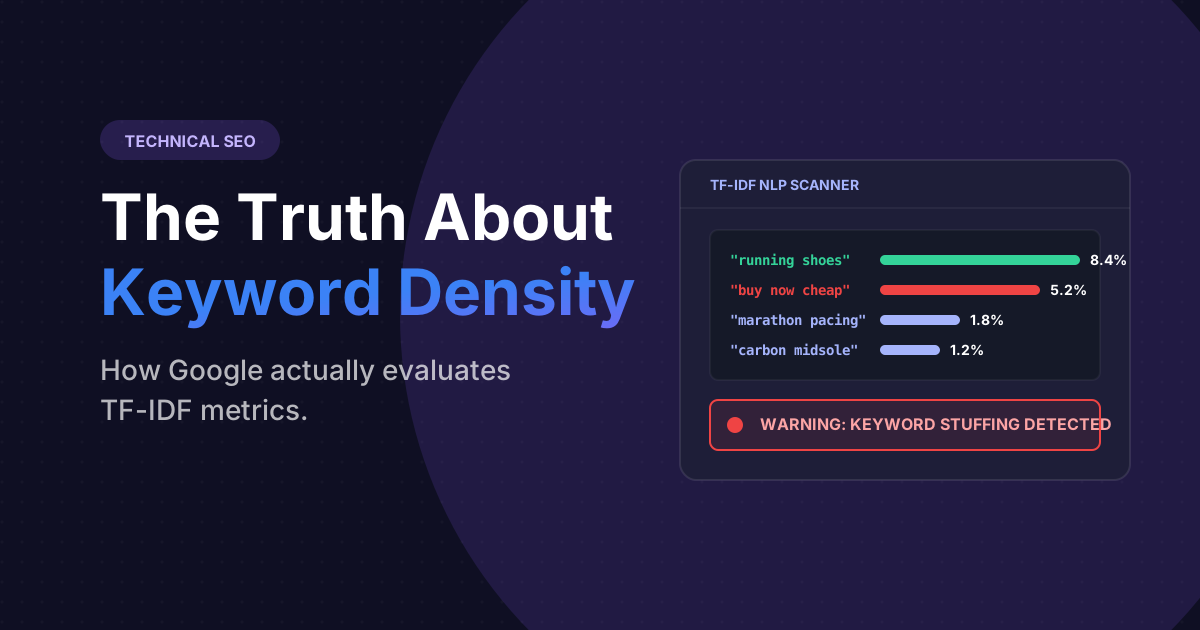
However, density is still a crucial diagnostic tool. If you run your article through a scanner and discover your core keyword sits at 8%, your writing reads like a robotic spam script, and you are actively risking a manual penalty.
Scan your content for spam triggers
Stop guessing. Paste your article into our free Keyword Density tool to instantly identify how many times you repeated specific phrases, and protect your domain ranking.
Launch Density ScannerThe TF-IDF Algorithm Explained
Instead of raw density, search engines evaluate weight using a mathematical concept called Term Frequency-Inverse Document Frequency (TF-IDF).
This equation evaluates how important a word is to a document based on how frequently it appears in a massive corpus (meaning billions of other webpages).
For example, the word "the" appears thousands of times in your article, but TF-IDF heavily discounts it because "the" appears on literally every page on the internet. However, if your article uses the phrase "Espresso Machine Boiler" seven times, and that phrase is incredibly rare across the broader internet, TF-IDF flags those words as the undeniable core thesis of your document.
Latent Semantic Indexing (LSI) & Topic Clusters
Google's BERT and MUM AI updates fundamentally shifted search from "Strings" to "Things". Google no longer just reads your exact phrase; it reads the contextual entities surrounding it.
If you want to rank for "Best Running Shoes in 2025", simply injecting that exact phrase 15 times will harm you. Instead, Google's AI expects to see a cluster of related semantic terminology spread naturally across the text. It looks for words like:
- Midsole cushioning
- Arch support
- Carbon fiber plates
- Marathon training pacing
This is semantic SEO. By writing comprehensive, expert-level content, these related concepts naturally appear. This proves to the algorithm that you possess deep, authoritative knowledge on the subject matter, not just a superficial keyword trick.
How to Audit Your Own Content Responsibly
You should still use a Keyword Density Checker before publishing, but your objective isn't to hit a target. Your objective is Spam Prevention.
Upon pasting your text into the Footprint Density tool, analyze the output list of 1-word, 2-word, and 3-word phrases. Identify the top 5 results. Do they accurately reflect the core topic of your article? Are you accidentally over-using a filler phrase like "as a result of" (which dilutes your TF-IDF score)? Adjust naturally, swap out repetitive words for synonyms, and ensure your copy flows like a human conversation.
Frequently Asked Questions
Google vastly reduced the ranking weight of Exact Match Domains back in 2012. While having your keyword in the domain name provides a microscopic brand relevancy signal, it is completely eclipsed by the actual quality of the content and the backlink profile of the host.
You should absolutely place your primary focus keyword inside your main H1 title. However, forcing it tightly into every sub-header (H2/H3) appears robotic and unnatural. Use LSI synonyms and highly descriptive secondary terms in your sub-headers instead to establish a broader topic cluster.
A safe, modern baseline is mentioning the primary keyword 3 or 4 times naturally throughout a 1,000-word document, ensuring it appears once within the first 100 words. Focus the remaining 99.5% of your effort on writing in-depth answers to the reader's question.