If you look at the address bar of your browser right now, you will notice exactly how this document is formatted. It does not end in a random string of algorithmic numbers. It explicitly ends with /blog/why-clean-url-slugs-are-seo-mandatory.html.
This is not a coincidence. This is a highly deliberate, calculated architectural decision. In the chaotic battleground of Google ranking dominance, every single microscopic detail impacts how the crawler indexes your content.
While content remains king, URL cleanliness is the absolute foundation of your canonical domain trust. This guide dismantles the exact mechanics of URL slugification and why dynamic pages kill massive traffic.
What Exactly is a "Slug"?
In internet parlance (originally derived from newspaper publishing lingo in the 1900s), the "Slug" is the final, human-readable section of a website address that explains identically what the page contains.
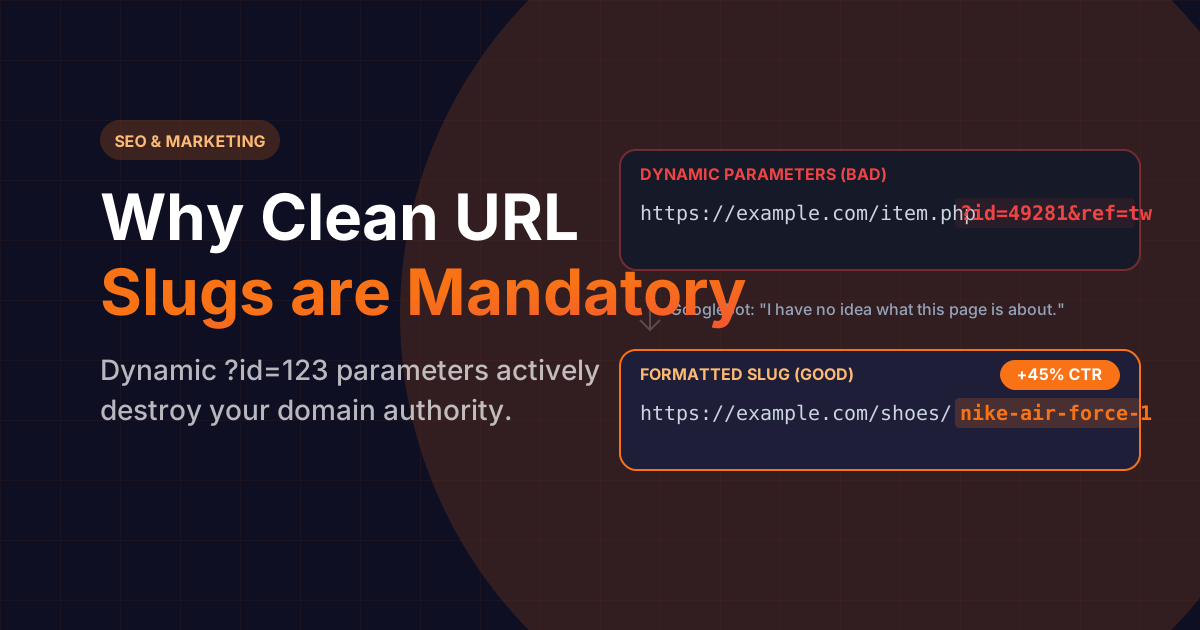
In store.com/category/shoes/nike-air-force, the massive string 'nike-air-force' is the slug.
The Flaw of Dynamic Parameters
Most novice developers build blogging systems using entirely dynamic URL parameters powered by database IDs. They look like this:
example.com/blog/view?id=49281&ref=twitterGoogle's web crawler (Googlebot) absolutely hates this. When the bot encounters an opaque ID tag like `?id=49281`, it receives zero semantic context about the payload of the page. It doesn't know if ID 49281 is an article about organic chemistry or an article about dog food.
Furthermore, parameters create catastrophic duplicate-content issues. `view?id=5&color=red` and `view?color=red&id=5` will structurally appear as entirely different websites to Google, causing penalization unless massive canonical maps are strictly enforced.
Format titles into Slugs instantly
Stop trying to manually replace spaces with dashes in your CMS codebase. Use our automated Regex processing tool to convert any massive title phrase into a perfectly 100% URL-safe, SEO-compliant slug string.
Launch URL Slugify GeneratorThe Psychology of the Click-Through Rate (CTR)
Clean Slugs don't just appease robots; they satisfy human psychology. In 2025, Google search places immense weight on User Behavior Signals. If your page ranks #3 on Google, but no one clicks it, you will get demoted to page 2.
When a user scans a Google search results page, they actively read the raw URL path displayed in green text. A URL that reads `/how-to-fix-plumbing-leaks` instantly builds trust with the searcher. A URL that reads `/?p=901a_v2` feels corporate, broken, or like a phishing scam. Humans overwhelmingly click the clean path, rocketing your CTR metrics upwards.
How to Algorithmically Clean Slugs
Creating a beautiful slug requires aggressive text manipulation. You cannot simply insert spaces into a URL, because spaces break HTTP protocols (browsers convert them automatically into ugly `%20` tags).
To safely slugify a title, your backend system must pass the string through a ruthless formatting engine:
- Convert all uppercase letters to strict `.toLowerCase()`.
- Detect all language spaces and replace them natively with hyphens (`-`).
- Detect all illegal characters (emojis, apostrophes, commas, exclamation points) and entirely strip them from the string.
These precise operations ensure you achieve the holy grail of modern web architecture: The Readable URL.
Frequently Asked Questions
Google has been explicitly clear on this for over a decade: Always use hyphens. Google's search crawler treats a hyphen as a word separator. It treats an underscore as a word joiner. `blue-shoes` is read as "Blue Shoes". `blue_shoes` is read as the massive single word "blueshoes".
WARNING: Proceed with caution. If your page `?id=5` already ranks well on Google and has massive established backlinks, changing the URL to `/cool-slug` will instantly break everything resulting in a 404 Error. You MUST deploy a highly strict HTTP 301 Permanent Redirect pointing the old ID directly to the new slug to preserve the SEO juice.
Yes. Short, highly focused slugs usually perform the best. If your article is titled "The 15 Best Running Shoes For Athletes With Flat Feet", your slug shouldn't mirror it perfectly. Cut it down to the highest value keywords: `/best-running-shoes-flat-feet`.