Why SERP CTR Matters More Than Backlinks Today

SERP CTR Machine Learning Optimization

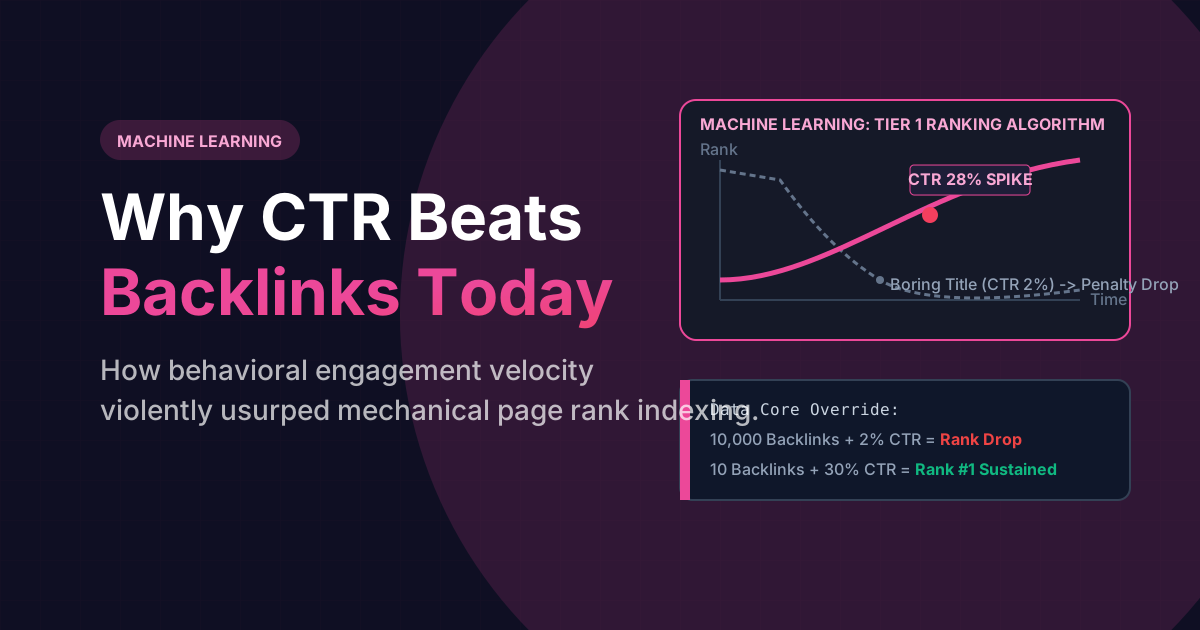
For twenty absolutely dominant years, the PageRank algorithm operated on a supremely mechanical formula: Whoever had the highest raw volume of incoming domain hyperlinks (backlinks), inherently ranked #1 structurally. Today, executing black-hat link farming fundamentally crashes your ranking.

Google natively realized that backlinks are wildly easily manipulated. Instead of counting mechanical robot-links, they deployed their immensely complex neural network to measure purely organic human behavioral metrics: Specifically, Click-Through Rate (CTR) and Pogo-Sticking velocity.

The Algorithmic Pogo-Sticking Shift

If your website brutally artificially manipulates links to reach position #2, the algorithm constantly watches user interaction physics. If 1,000 humans search for "Best Laptop", they see your blue link. If your meta title is horribly boring and only 2% physically click it, the math engine flags you.

Worse, if a user actually clicks your link, discovers your web layouts are horrifyingly obsolete, and immediately violently clicks the "Back" button to return to Google (a metric defined as Pogo-Sticking), the neural network immediately severely drops your rank array regardless of how many million backlinks point to your URL structure.

Visualize Your Output Pixel Layouts

Do not guess exactly how your 60-character title strings layout visually on mobile architecture screens. Physically type your metadata strings actively into our live testing suite to maximize visual CTR potential.
Launch Live SERP Snippet Preview Tool

Capitalizing Meta Title Layouts

Because the modern algorithm actively dynamically reorganizes the ranking list natively based on human CTR physics, aggressively engineering your `` strings and `<meta name="description">` blocks yields monumentally faster organic scaling than dropping comments on obsolete forum boards.</p> <p>Using strict exact-match bracket brackets `[Updated 2025]` natively captures eyeball attention matrix physics. Adding explicit mathematical numbers inside arrays radically spikes engagement. If you are positioned at #6 natively, but absolutely overwhelmingly dominate the CTR metrics of #4 and #5, the algorithm mathematically forces you upward within active weeks.</p> <h2 id="faq" class="faq-section">Frequently Asked Questions</h2> <div class="faq-list"> <div class="faq-item"> <button class="faq-question"> What is the perfect title length? <svg class="faq-icon" width="20" height="20" viewBox="0 0 24 24" fill="none" stroke="currentColor" stroke-width="2"><path d="M6 9l6 6 6-6"/></svg> </button> <div class="faq-answer"> <p>Google doesn't explicitly restrict character counting, they physically measure pixel rendering width across device formats. Technically, keeping your array string under fundamentally 60 characters comprehensively prevents violent algorithmic ellipsis `...` string cropping.</p> </div> </div> <div class="faq-item"> <button class="faq-question"> Are Backlinks totally dead? <svg class="faq-icon" width="20" height="20" viewBox="0 0 24 24" fill="none" stroke="currentColor" stroke-width="2"><path d="M6 9l6 6 6-6"/></svg> </button> <div class="faq-answer"> <p>Absolutely not. High-authority contextual backlinks algorithmically allow your brand-new domain node to strictly securely enter the testing array (Page 1 or 2). From there, behavioral CTR metrics massively take complete computational control of your absolute final exact ranking tier.</p> </div> </div> <div class="faq-item"> <button class="faq-question"> Does Google rewrite my titles? <svg class="faq-icon" width="20" height="20" viewBox="0 0 24 24" fill="none" stroke="currentColor" stroke-width="2"><path d="M6 9l6 6 6-6"/></svg> </button> <div class="faq-answer"> <p>Extremely frequently. If the search algorithm mathematically concludes that your `<h1>` tag more natively completely answers the exact user's search query logic than your `<title>`, it will forcefully physically rewrite the layout structure inside the organic SERP display instantly.</p> </div> </div> </div> <div class="ad-slot" data-ad-slot="blog-bottom"></div> </article> </div> </main> <footer class="footer"> <div class="container"> <div class="footer-bottom"> <span>© 2025 Footprint. All rights reserved. | <a href="https://footprint.co.in/">footprint.co.in</a></span> </div> </div> </footer> </div> <script src="/src/js/shared-nav.js"></script> <script src="/src/js/shared-footer.js"></script> <script src="/src/js/categories.js"></script> <script src="/src/js/app.js"></script> <script src="/src/js/protect.js"></script> <script src="/src/js/adsense.js"></script> <script src="/src/js/breadcrumbs.js"></script> <script> document.querySelectorAll('.faq-question').forEach(button => { button.addEventListener('click', () => { const item = button.closest('.faq-item'); const isActive = item.classList.contains('active'); document.querySelectorAll('.faq-item').forEach(faq => faq.classList.remove('active')); if (!isActive) item.classList.add('active'); }); }); </script> </body> </html>