Statistically, the average internet user has over 130 different online accounts. Between social media, streaming services, online banking, grocery deliveries, and work portals, modern humans simply cannot memorize 130 unique strings of gibberish.
So, we do what humans naturally do: we compromise. We create one "really strong" password, like BlueDolphin!2015, and we use it everywhere.
From a psychological standpoint, it makes perfect sense to reuse a password. From a cybersecurity standpoint, it is the digital equivalent of using the exact same master key to unlock your house, your car, your office, and your bank vault, and then leaving copies of it all over the city.
The Psychology of the "Strong" Password
Most people wrongfully assume that internet hackers target individual humans. In the movies, a hacker stares at a screen and physically guesses passwords to break into the main character's email account.
This does not happen in the real world.
Hackers do not care how mathematically "strong" your password is. It does not matter if your password is 100 characters long with 50 special symbols. Why? Because hackers don't guess passwords. They wait for servers to leak them.
The "Weakest Link" Breach Model
Your online security is only as strong as the single weakest website you use.
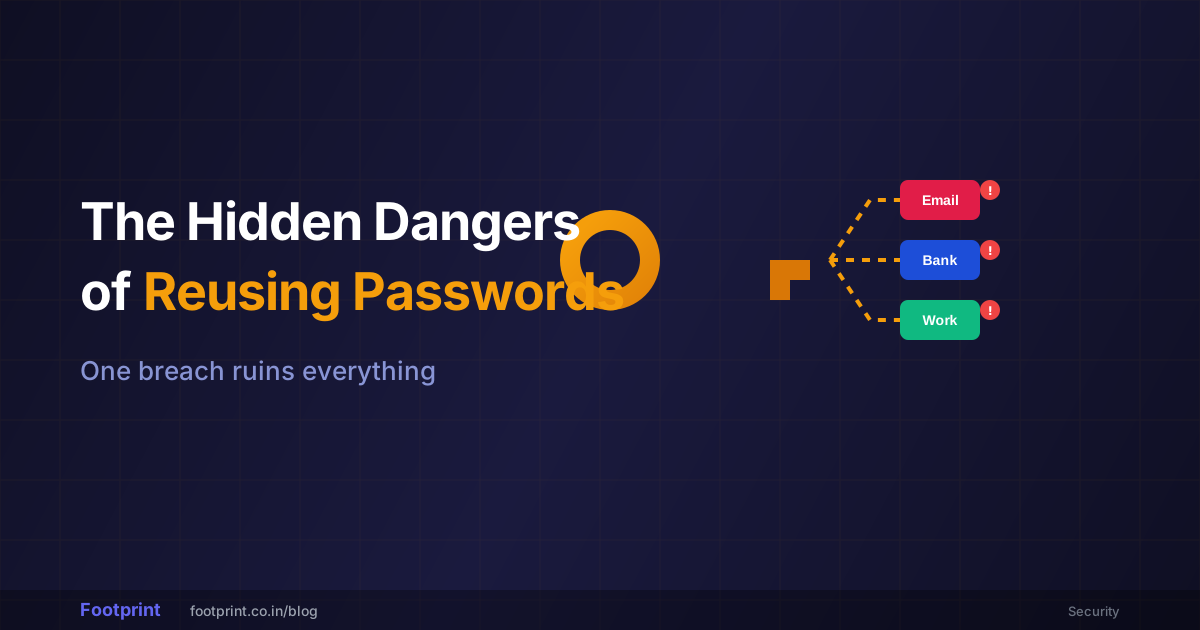
Imagine you use the same password (BlueDolphin!2015) for your fiercely protected JP Morgan Chase bank account, and for a tiny, barely-maintained online forum where you discuss gardening.
A Russian hacking team will never try to hack JP Morgan Chase. Their mainframes are protected by millions of dollars of cybersecurity infrastructure. Instead, the hacking team will target the tiny gardening forum. The forum has terrible security. With one simple SQL injection, the hackers download the entire forum's user database and expose your email and your password in plain text.
The hackers now possess your "master key." Because you reused it, they now have full control over your bank account, your Amazon profile, and your Gmail, all because a gardening blog had weak security.
The Machine: How "Credential Stuffing" Works
When hackers steal 500,000 passwords from a website breach, they do not manually type them in. They use an automated cyberweapon known as Credential Stuffing.
The hackers upload the massive list of stolen emails and passwords into a botnet script. On autopilot, this script travels to Amazon.com, PayPal.com, and Facebook.com. In extreme rapid-fire sequence, the bot attempts to log into Amazon using the 500,000 stolen credentials.
If you reused your password, the bot logs in instantly. The script immediately buys expensive electronics using your saved credit card, changes the shipping address to a drop-house, logs out, and moves to the next victim. A credential stuffing bot can ruin a thousand lives in sixty seconds.
Before reading the rest of this article, you should objectively test the current strength of your "master" password using our Password Strength Checker. It analyzes complexity using identical logarithms to modern hacking tools.
⚙️ Auditor: Check Your Current Password's Entropy →
The Myth of "Adding a Number" (Iteration)
A common, fatal mistake people make when told not to reuse passwords is to use Password Iteration. This is when you use BlueDolphin1 for Facebook, BlueDolphin2 for Twitter, and BlueDolphin3 for Netflix.
Credential Stuffing algorithms are coded by brilliant mathematical engineers. The bots are explicitly programmed to anticipate human iteration. If the bot steals BlueDolphin1 from a data breach, it will automatically test BlueDolphin2, BlueDolphin!, and BlueDolphin2025 during its attack run. Iteration provides exactly zero extra security.
How to Break the Habit (The Only Real Solution)
There is only one strategy to protect yourself from global data breaches: Zero Trust Architecture.
You must assume that every website you use will be hacked tomorrow. The only way to survive that hack is to ensure the stolen password cannot be used anywhere else.
- Embrace Randomness: Every single website you use must have a completely unique, 20-character string of random gibberish that has nothing to do with your life. No birth years, no pet names.
- Use Generation Tools: Human brains cannot create true randomness. Use our Cryptographic Password Generator to instantly create impossible-to-crack, unique keys for every new account you make.
- Adopt a Manager: Use an encrypted vault (like Bitwarden, 1Password, or Apple Keychain) to store these massive, complex passwords. You only need to memorize one single "Master Password" to unlock the vault. The vault remembers the other 130 passwords for you.
🔐 Generate Your First Cryptographic Zero-Trust Password →
Conclusion
The habit of password reuse was born out of the innocent desire to make life easier in the early days of the internet. Today, it is the single largest vulnerability in global consumer cybersecurity. A single data breach on a tiny, forgotten website can result in absolute financial devastation if you recycle your credentials. Adopt a password manager today, randomize your digital footprint, and make credential-stuffing bots completely useless against you.