If you build an e-commerce platform and successfully integrate Stripe or PayPal, you natively rely on automated "Webhooks" to verify your transactions. When a customer pays $500, Stripe physically fires an HTTP POST packet to your backend listener sequence (`/api/webhook`), commanding your code to upgrade the user's account dashboard.
But the open web is horrifyingly dangerous. What actively stops a hacker from writing a localized Python script to aggressively bombard your completely public `/api/webhook` address with fake data packets claiming they successfully paid? The answer is HMAC Authentication.
The Catastrophic Billing Loophole
Without physical cryptographic trust, you cannot trust a webhook. If you simply read the JSON body `{"paid": true, "amount": 500}`, a hacker trivially bypasses the entire billion-dollar Stripe payment gateway pipeline natively.
To mathematically seal this terrifying loophole, the Hash-based Message Authentication Code (HMAC) protocol was architected explicitly to guarantee data origin integrity across entirely open networks.
Symmetric Secret Keys
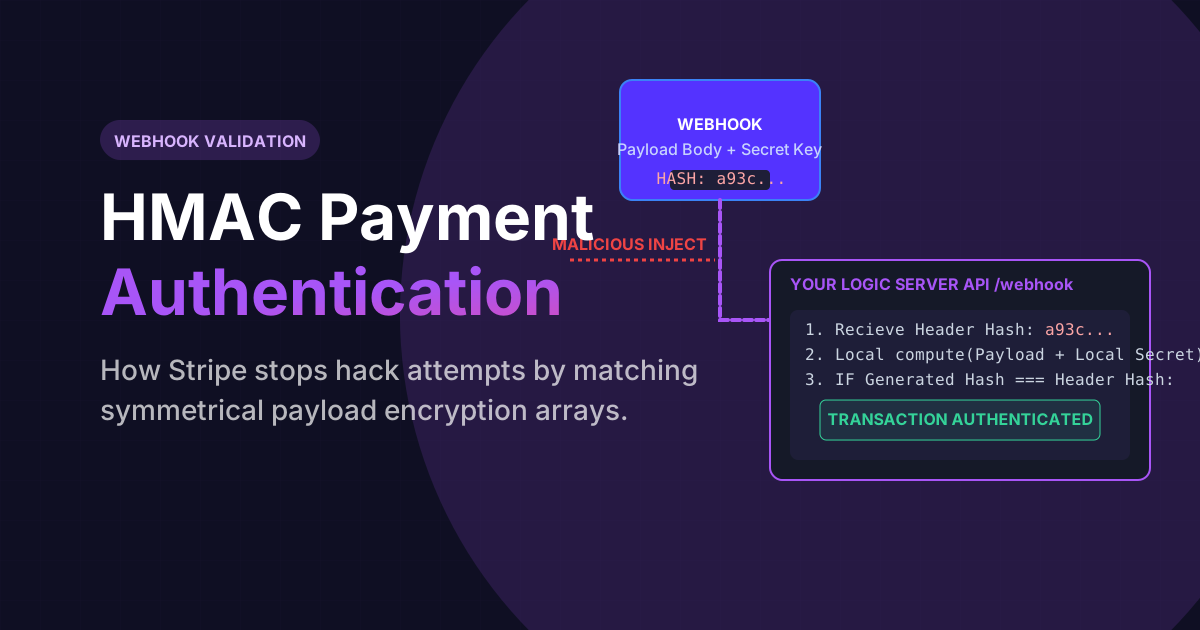
When you configure Stripe, they secretly hand your server an incredibly long cryptographic "Signing Secret Array" (`whsec_1234abc...`). Stripe natively holds identical geometry. When Stripe officially fires the webhook packet, they take the entire JSON payload body, mathematically combine it with the secret key, calculate the SHA-256 string, and strictly attach the output code natively into the HTTP header sequence (`Stripe-Signature`).
Calculate Raw HMAC Signatures
Do not guess webhook authentication logic structures. Load your raw payload stream and signing key symmetrically into our dedicated cryptographic protocol tool to visually verify the matching hash sequence.
Launch Live HMAC GeneratorTotal Immunity to Manipulation
The profound beauty of this engineering logic is that when your server physically receives the packet, it naturally replicates the exact same mathematical formula using its own stored secret key. If the calculated hash flawlessly matches the HTTP header stream hash, you inherently mathematically guarantee two things:
- Origin Match: Only the absolute entity holding the private secret key (Stripe) could have physically produced the signature.
- Data Integrity: The hacker didn't alter the `$50` payment to `$500` midway during TCP transit, because changing a single micro-byte natively destroys the entire hash structure verification.
Frequently Asked Questions
If you naively use a standard `==` string operator to verify the HMAC signature hash, a hacker natively pings your server billions of times, physically measuring the microscopic millisecond latency drop when the first letter matches. Modern Node modules utilize mathematically constant-time comparison buffers (`crypto.timingSafeEqual`) to entirely block this.
Always map the absolutely raw, unparsed HTTP byte stream string. If your Express router natively parses the string into a localized object via array conversion, it introduces tiny invisible spacing differences that brutally crash the mathematical verification hash.
Corporate gateways physically embed a UTC unix timestamp code directly inside the HTTP header structure calculation array. If your server processes an incoming webhook bearing a timestamp older than five strict minutes, your server mathematically deletes the entire structure forcefully as a replay assault.