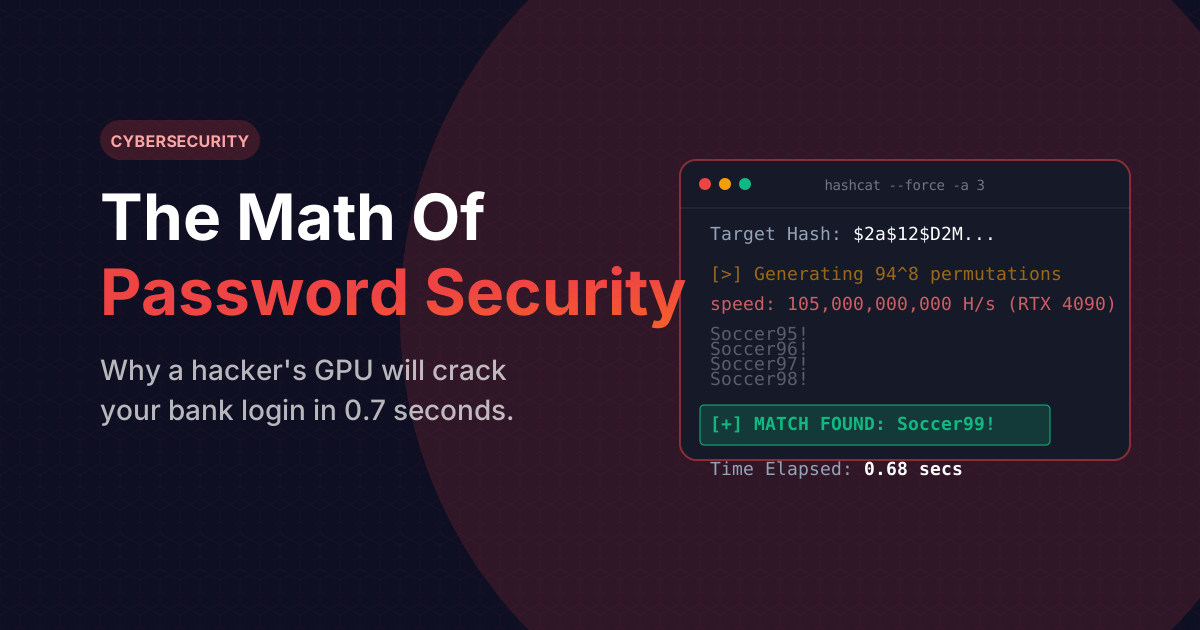
If your current bank password is Soccer99!, you operate under a false sense of security. You likely believe that because it contains a capital letter, a number, and an exclamation point, it is incredibly complex. You likely think it would take an attacker months to guess it.
In reality, a modern GPU rig running Hashcat can crack that exact password in less than 0.7 seconds.
Humans are notoriously terrible at creating passwords because we fundamentally misunderstand how computers attempt to crack them. We assume the attacker is sitting at a keyboard typing guesses. In truth, cybersecurity attacks are executed by heavily parallelized mathematical supercomputers. In this guide, we break down the terrifying math of modern password hashing, and why length entirely dominates complexity.
Why Hackers Don't Steal Your Actual Password
When you register for a modern website, they (hopefully) do not save your password in their database. Instead, they run your password through a cryptographic algorithm (like bcrypt or SHA-256) which scrambles it into a fixed-length string called a Hash.
Soccer99! becomes something like: $2a$12$D2M/.../XG9D3Z13o9
When a massive server breach occurs (which happens weekly to major corporations), hackers steal a giant database filled with millions of these hashes. They cannot simply copy-paste the hash to log into your account. They must mathematically reverse it. This is where brute forcing begins.
The Threat of Dictionary Attacks
Attackers do not start guessing "aaaaaa". They start with a Dictionary Attack. Hackers possess massive, 50-Gigabyte text files containing every word in the English language, every proper noun, every movie title, and every previously leaked password in human history.
Their computer rapidly hashes the word "Soccer". That takes milliseconds. It doesn't match your stolen hash. It then hashes "Soccer1", "Soccer2", "Soccer99". It then appends common symbols "Soccer99!". Suddenly, their generated hash perfectly matches your stolen hash.
Boom. Your account is breached. If your password contains a dictionary word of any kind, your complexity is essentially zero.
Generate true entropy instantly
Stop using words. Generate 24-character, fully randomized cryptographic strings directly in your browser using our secure tool.
Launch Secure Password GeneratorThe Mathematics of Brute Force Entropy
If an attacker must resort to a pure Brute Force attack (guessing every single possible character combination randomly), we can calculate exactly how long it takes utilizing the mathematics of Information Entropy.
The formula for total possible combinations is: CL
(Where C is the number of Possible Characters, and L is the Length of the password).
Lowercase only (26 characters):
26^8 = 208 Billion combinations.
A high-end RTX 4090 GPU guesses ~100 Billion per second.
Time to Crack: 2 Seconds.
So, you add numbers and symbols, utilizing the full keyboard (94 characters) but keep it at 8 characters long.
94^8 = 6 Quadrillion combinations.
Time to Crack: 16 Hours.
Sixteen hours is mildly annoying for a hacker, but ultimately trivial. Your account is still breached by the next morning.
Length Destroys Complexity: The Golden Rule
The human brain thinks adding exclamation marks increases security. Math proves that Length is infinitely more powerful.
What if, instead of adding crazy symbols, we use ONLY lowercase letters, but increase the length to 16 characters?
26^16 = 4.3 × 10^22 combinations.
Time to Crack: 13,000,000 Years.
By simply typing a longer sequence, you have defeated the supercomputer. A 16-character password comprised entirely of random lowercase letters is mathematically millions of times stronger than an 8-character password packed with crazy symbols.
How to Generate Uncrackable Strings
The ultimate password utilizes both massive length (16+ characters) and the full character set (94 characters). This brings the cracking time to trillions of millennia, rendering the heat-death of the universe a closer concern than your account being hacked.
However, the human mind is incapable of writing truly random sequences. We naturally type patterns on the keyboard (like 'qwerty' or '1234'). Using a browser-based algorithmic password generator leverages true cryptographic entropy (utilizing the `crypto.getRandomValues()` protocol inside your operating system). By generating these strings securely and storing them in a Password Manager, you render brute force attacks physically impossible.
Frequently Asked Questions
Passphrases use 4 or 5 completely random dictionary words strung together. They rely on massive length (often 20-30 characters) which mathematically defeats brute force, while remaining easy for a human to memorize. They are an excellent strategy for master passwords.
Grover's Algorithm running on a theoretical quantum computer effectively cuts the entropy of hashes in half. A hacker trying to crack AES-256 would suddenly experience it as easily as cracking AES-128. The solution is simple: increase string lengths drastically over the next decade.
If a website can email you your existing password in plain-text, delete your account immediately. This explicitly proves they are not hashing their database, but storing your credentials in plain text. It is a catastrophic, foundational security failure.