If you watch a modern police procedural on television, you will inevitably hear a detective dramatically declare that the killer was hired "on the Dark Web." The scene usually features a teenager in a hoodie typing furiously while ominous techno music plays.
Media sensationalism has turned the Dark Web into a mythological bogeyman. People assume it is a single, terrifying website where you accidentally click the wrong button and the FBI shows up at your door.
This is a guide to getting the dark web explained through actual computer science, not movie tropes. To understand what is actually down there, you have to understand the three distinct layers of the internet: the Surface, the Deep, and the Dark.
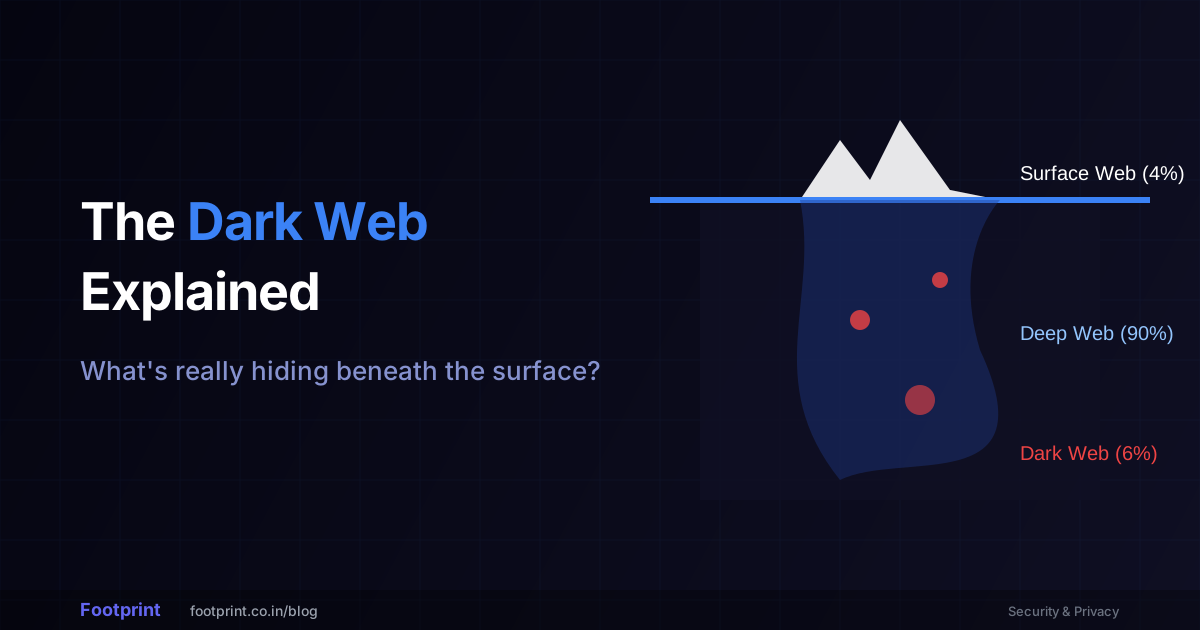
The Internet Iceberg Analogy
Security researchers universally use an iceberg to describe the scale of the internet. The part of the iceberg sitting above the water line—the part anyone driving by in a boat can clearly see—is incredibly small. The vast majority of the iceberg's mass is submerged cleanly out of sight.
Layer 1: The Surface Web
The Surface Web is the tip of the iceberg above the water. It consists of any web page that can be found using a traditional search engine like Google or Bing.
When you Google "Wikipedia" or "New York Times," the search engine provides a direct link. However, Google's "spiders" (the bots that crawl the internet to build their database) only index publicly accessible pages. Shockingly, the Surface Web—which contains every YouTube video, every public tweet, and every news article you have ever read—makes up less than 5% of the total internet.
Layer 2: The Deep Web (You Are Already Using It)
Most journalists make the massive mistake of using the terms "Deep Web" and "Dark Web" interchangeably. They are completely different things.
The Deep Web is the massive, mundane chunk of the iceberg sitting just below the water line. It simply refers to any website on the internet that is legally blocked from Google's search algorithms.
You use the Deep Web every single day. The Deep Web includes:
- Your private email inbox. (Google cannot index the emails inside your Gmail account).
- Your online banking dashboard behind a login screen.
- A private, password-protected corporate intranet.
- Medical records stored on a hospital server.
- Paywalled newspaper articles.
There is absolutely nothing illegal or scary about the Deep Web. It is just the necessary, boring, and highly secure infrastructure required to keep private data private.
Layer 3: The Dark Web
At the absolute bottom tip of the iceberg lies the Dark Web. It makes up less than 0.1% of the total internet structure.
The Dark Web is a subset of the Deep Web, meaning it is not indexed by Google. But it goes one massive step further: The Dark Web physically cannot be accessed by standard web browsers like Chrome, Safari, or Edge. The sites do not end in .com or .org. They usually end in .onion.
To access the Dark Web, you must download a highly specialized application called the Tor Browser (The Onion Router). The Tor network was actually originally funded by the United States Navy Naval Research Laboratory in the 1990s as a method to protect government intelligence communications over public internet lines.
How ".onion" Routing Actually Works
When you use Google Chrome (the Surface Web), your computer connects directly to the server you want to visit. The server can physically see your home IP address (the unique digital identifier of your house). If you want to check your public visibility, you can use our IPv4 / IPv6 Tool to see exactly what public servers see when you connect to them.
🌐 Check Your Public IP Address Visibility →
The Dark Web abandons this direct connection model entirely.
When you use the Tor browser to visit an .onion website, your connection does not go straight there. Your internet traffic is heavily encrypted and violently bounced (routed) through three different, randomly selected volunteer computers scattered around the globe.
- The Entry Node knows who you are, but the data is encrypted so it can't see what you are doing.
- The Middle Node just blindly passes the tangled data along.
- The Exit Node finally decrypts the data and visits the website, but because it only knows about the Middle Node, it has absolutely no idea who you are.
This is called "Onion Routing" because the encryption is wrapped in thick, complex layers, just like an onion. Because of this chaotic global bouncing, the Dark Web is incredibly slow. The trade-off for this terrible speed is mathematical anonymity. It is almost impossible for a government or ISP to track a user's physical location.
(Technical Note: You can verify standard internet routing structures by using our HTTP Headers Checker to see how normal Surface Web data is requested and fulfilled in plain text).
🔍 Inspect Surface Web Headers →
Who Actually Uses the Dark Web?
The anonymity of the Dark Web provides a completely unfiltered platform for human behavior, which results in a stark dichotomy of users.
The Illicit Economy
Yes, the legends are partially true. Because law enforcement struggles to track users, the Dark Web hosts massive, eBay-style black market forums. Cybercriminals use cryptocurrency to buy and sell stolen databases of passwords, illegal narcotics, forged government passports, and malware payloads. (However, "hiring assassins" is almost universally a scam run by hackers to steal Bitcoin from gullible teenagers).
The Vital Humanitarian Defense
Crucially, the Dark Web is also a literal lifesaver. In countries dominated by oppressive, authoritarian regimes that heavily censor the internet and track citizens, the Dark Web is the only way journalists and whistleblowers can safely communicate with the outside world. Major news organizations like the New York Times and the BBC host physical .onion dropsites on the Dark Web so whistleblowers can anonymously submit evidence of corporate or government corruption without fear of retaliation.
Conclusion
The internet is far more complex than just typing a URL into a search bar. The vast majority of the data online is securely locked away in the Deep Web to protect your privacy. Meanwhile, the Dark Web serves as the chaotic, uncensored underbelly of the digital realm—a technological frontier that simultaneously protects political dissidents and harbors global cybercriminals.