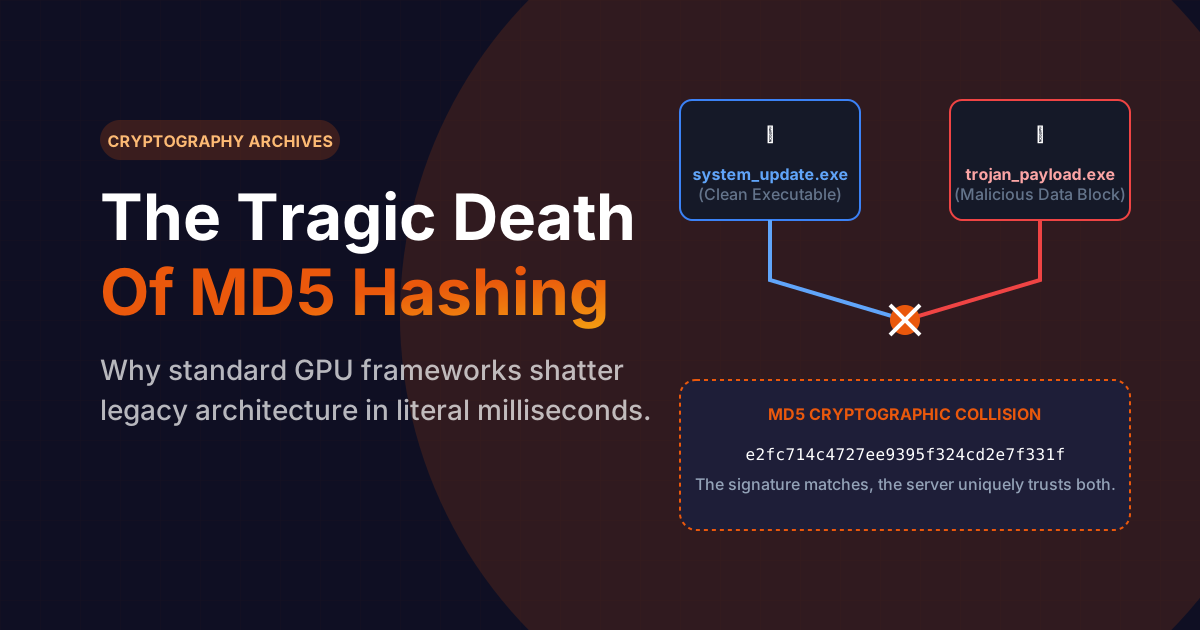
Created in 1992 by cryptography legend Ronald Rivest, the Message-Digest Algorithm 5 (MD5) defined the entire early security architecture of the public internet. Almost every single forum password, software installer package, and database structure from 1995 to 2010 was securely wrapped in the iconic 32-character hexadecimal MD5 format.
Today, the United States Department of Homeland Security specifically lists MD5 code in production as a critical, unpatchable vulnerability. Here is exactly why the legendary math formula was utterly shattered by modern hardware advancements.
The Collision Catastrophe
The core promise of a Cryptographic Hash function is absolute uniqueness. If you feed the word "Apple" into a hashing algorithm, and then you feed the word "Apple" again, you should get the precise identical hash signature output. If you feed the word "Apples", the signature must radically change entirely.
This explicitly mathematically requires that no two different files can ever result in the same hash output. By 2004, security researchers discovered a catastrophic vulnerability inside MD5's core processing loop: Hash Collisions. Hackers discovered how to physically craft a malicious virus executable file that would mathematically generate the exact same MD5 signature as a legitimate Microsoft Word update packet. MD5's central architectural promise was mathematically destroyed overnight.
The GPU Brute Force Apocalypse
Beyond collisions, MD5 lacks the computational armor required to survive modern silicon processors. MD5 is an incredibly "fast" mathematical algorithm explicitly designed to run on weak 1990s CPU architecture. It only takes a billionth of a second to calculate.
Fast forward to today's cloud architecture. A hacker renting a standard Nvidia GPU mining rig can blast through roughly **50 to 100 billion unique MD5 hashes per single second**. If your company database leaks its MD5-protected user passwords, the hacker's hardware physically brute forces every possible combination and cracks 99% of your user passwords instantaneously.
Visualize Legacy MD5 Outputs
Do not utilize MD5 to protect user security payloads. However, if you natively need to process legacy caching structures or check rapid file integrity, utilize our dedicated generator interface.
Launch MD5 Calculation RigIs MD5 Still Useful At All?
Yes, but strictly outside the boundaries of cyber security. MD5 is an incredibly fast, highly efficient processor checksum tool. If you are copying a colossal 500GB video file from your laptop hard drive to a flash drive, scanning the file with MD5 before and after the transfer confirms that absolutely zero digital bytes were randomly corrupted during USB transit.
MD5 is spectacular for detecting accidental hardware errors, but it is dangerously useless at preventing intentional hacker manipulation.
Frequently Asked Questions
For file integrity and general data hashing, use SHA-256 (part of the SHA-2 family). For explicitly storing user passwords in databases, you must use a slow, memory-hard hashing algorithm actively designed to resist GPU attacks, such as strictly `bcrypt` or `Argon2`.
Rainbow tables are massive pre-calculated lookup databases containing billions of common passwords and their matching MD5 signatures. Hackers instantly query the table instead of doing any math. This is why "Salting" passwords (adding random hidden strings before hashing) destroys rainbow table validity.
Yes. SHA-1 (the cryptographic successor to MD5) was officially shattered by researchers at Google explicitly in 2017 when they successfully executed the "SHAttered" collision attack against two distinct PDF files.