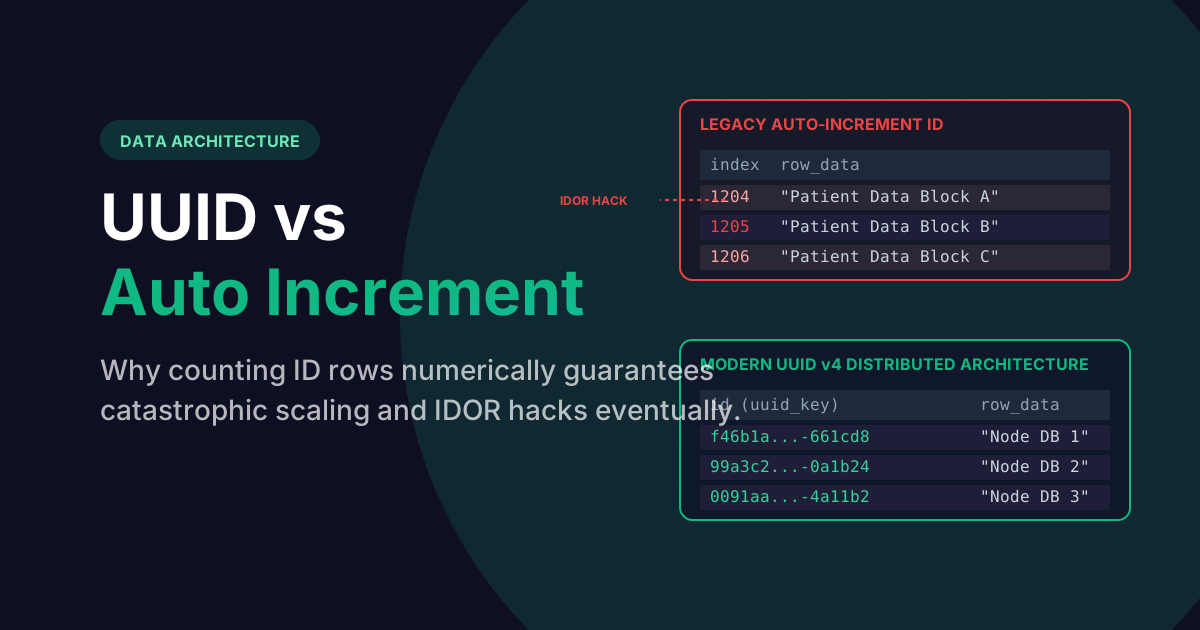
For decades, almost every SQL database in existence utilized a standard auto-incrementing integer (`ID 1`, `ID 2`, `ID 3`) for primary keys. It was explicitly the fastest, most incredibly lightweight indexing structure theoretically possible in computer architecture.
However, modern web development framework scaling violently destroyed the auto-increment integer. Today, almost every enterprise massively utilizes Universally Unique Identifiers (UUID). Here is the explosive architectural debate between sequential integers and massive 128-bit randomized hash blocks.
The Catastrophic IDOR Vulnerability
The single greatest argument against using Auto-Incrementing IDs in a public web application is an attack vector explicitly known as Insecure Direct Object Reference (IDOR). If a user logs into your medical portal and sees their URL is `/patient?id=500`, they can simply maliciously edit the URL string to `/patient?id=501`.
If your backend permission logic possesses a single microscopic logic flaw, the system will natively retrieve patient 501's highly confidential data. The sequential integer publicly leaked your data layout logic and leaked to investors exactly how many users actively existed on the database (precisely 501 users).
UUID v4 (`123e4567-e89b-12d3-a456-426614174000`) entirely blocks this. Even if a user knows their personal sequence, guessing another valid 128-bit randomized block is mathematically impossible before the heat death of the physical universe.
Generate Cryptographically Secure IDs
Do not rely on Javascript's standard Math.random() object generator to secure database architecture strings. Mechanically produce flawless v4 identifiers utilizing our dedicated global uniqueness generator.
Launch Global UUID Architecture ToolUUIDs in Distributed Cloud Systems
The second phenomenal advantage of UUIDs is global architectural scaling logic. If your database operates heavily across massive horizontal cloud nodes (AWS multi-region scaling), explicitly attempting to sync an auto-incrementing integer across the Atlantic Ocean causes horrific system deadlocks.
If completely isolated server nodes mathematically generate a UUID v4 payload simultaneously, the astronomical entropy space technically guarantees zero sequence overlap natively without ever needing central network sync validation.
Frequently Asked Questions
Yes. A UUID consumes 128 bits of hard drive RAM compared to a clean 32-bit integer array. Because UUID v4 hashes are entirely randomized, they catastrophically shatter B-Tree index sorting logic, frequently slowing down global search table scans radically.
The new UUID v7 specification physically encodes the current localized Unix timestamp structurally into the very beginning layout of the long hash. This perfectly marries global entropy logic while naturally remaining entirely sortable sequentially inside the index tree.
Absolutely. Many massive corporations (like Stripe and Discord) utilized highly optimized 64-bit structures (Snowflake IDs or NanoIDs), strictly compressing sortable temporal entropy blocks into much smaller server data arrays.