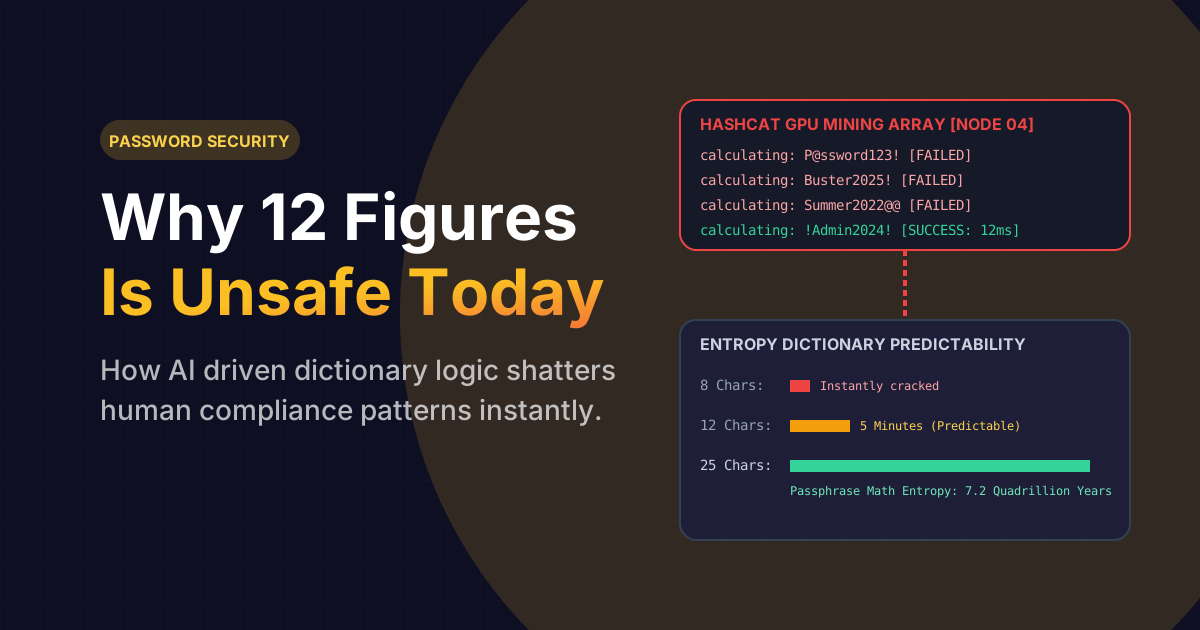
For decades, enterprise corporate security policies universally mandated a strict 8-character password. As modern processing speeds evolved, IT departments incrementally ratcheted the baseline up to 10 bytes, and eventually to the widely accepted 12-character golden standard containing an uppercase letter, a number, and a punctuation mark (`!Summer2022!`).
Today, utilizing an exceptionally predictable 12-character string fundamentally guarantees compromise. The physical hardware running brute-force hashing calculations has advanced so terrifyingly fast that length alone no longer provides adequate mathematical entropy against dedicated GPU botnets.
Moore's Law Destroys Entropy
A standard 8-character password contains essentially zero mathematical entropy. An off-the-shelf gaming graphics card (like the RTX 4090) executing the Hashcat cracking software can attempt a staggering **100 billion combinations per second**. It systematically chews through every single possible 8-character combination (lowercase, uppercase, symbols) in approximately 45 minutes.
If you extend the password to 12 characters (`Password123!`), you technically expand the mathematics. Unfortunately, humans possess an overwhelming psychological hatred for randomized static text memory. Instead of choosing a truly random 12-character block (`gF9#cL2qPz!1`), humans predictably append the current Julian calendar year and an exclamation mark to their dog's name (`Buster2025!`).
The Hybrid Neural Attack
Modern cracking routines stopped blindly guessing "AAAA" then "AAAB" long ago. Hackers utilize highly advanced dictionary lists specifically fed through probabilistic AI logic patterns. The attacker network instantly recognizes the human psychology heuristic.
Their dictionaries explicitly prioritize capitalizing the first letter, instantly throwing in pet names, and appending sequence digits identically mimicking your "complex" rule requirements. Your 12-character password mathematically falls in literally seconds because it structurally matched the predictable statistical human pattern.
Calculate Cryptographic Thresholds
Do not rely on gut-feeling intuition to secure your root infrastructure protocols. Mechanically verify exact mathematical cryptographic timing resilience using our dedicated entropy analyzer algorithm.
Launch Entropy Strength MatrixThe Rise of the Passphrase
To mathematically defeat silicon GPU clustering, length overwhelmingly beats arbitrary character complexity. The new cybersecurity gold standard is the **Passphrase**. Connecting four completely random dictionary words (`batteryhorsepurpletable`) generates a radically massive 25-character string.
This colossal expansion radically breaks the mathematics. It would take modern supercomputer nodes billions of years to physically parse the string array calculations, and the lack of complex symbols structurally guarantees you will actually psychologically remember the code sequence.
Frequently Asked Questions
Absolutely not. The NIST (National Institute of Standards and Technology) explicitly updated their guidelines actively condemning 90-day password cycling. When forced to cycle, humans instinctively predictably increment a trailing number (`Pass1!`, `Pass2!`), making the network radically less secure.
Passkeys are the highly anticipated successor protocol explicitly designed to completely murder the structural password entirely. They rely securely on massive biometric physical hardware authentication (FaceID/Fingerprint) natively linked to secure FIDO2 global asymmetric network protocols.
While massive structural breaches have targeted manager vendors (like LastPass), statistically, storing 150 highly complex mathematical 32-character strings inside a manager architecture is infinitely safer than reusing `Password2025!` aggressively across 150 discrete corporate websites.