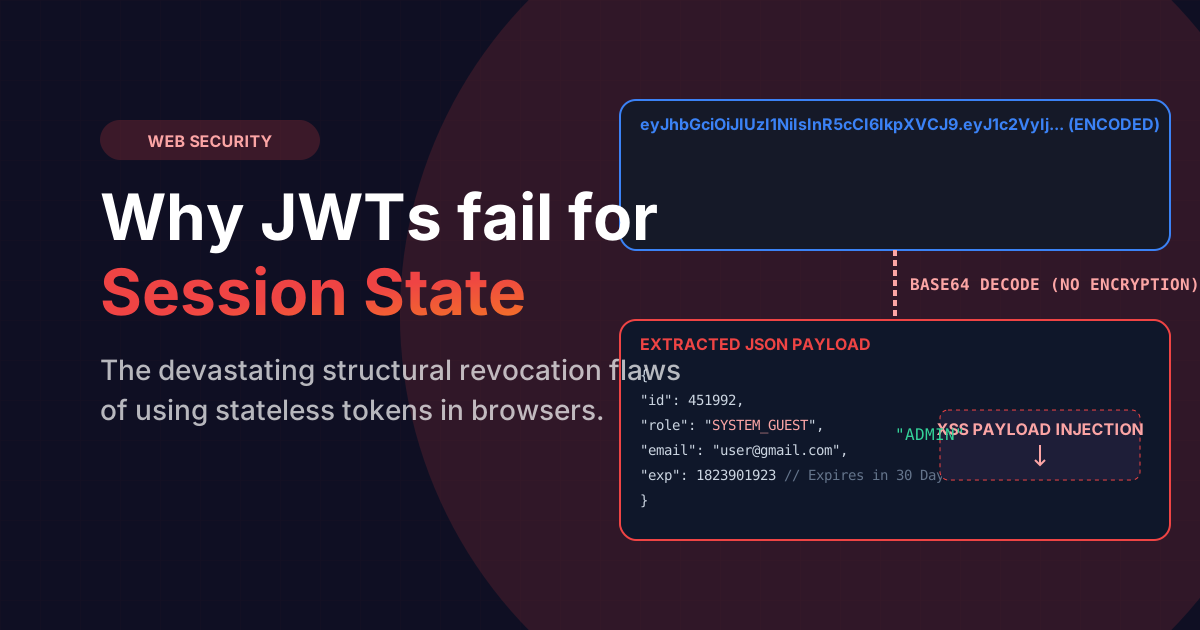
Over the last decade, Single Page Applications (SPAs) like React and Vue aggressively popularized the usage of JSON Web Tokens (JWT) for user authentication. The prevailing narrative stated that traditional server-side cookies were obsolete, and stateless JWTs enabled infinite algorithmic scaling without hitting a database.
Unfortunately, deploying JWTs as long-lived browser session tokens is widely considered by cryptography architects to be a devastating architectural anti-pattern. JWTs were never mathematically designed to handle user login sessions.
The Myth of Stateless Scaling
The primary benefit of a JWT is that it is stateless. When a user logs in, the backend cryptographically signs a string payload (e.g. `{"user_id": 45}`) and hands the token to the client. When the client makes future requests, the server simply verifies the cryptographic signature natively on its CPU without ever pinging the database.
This theoretically eliminates database bottleneck loads. However, the second your business requirements demand that you check if the user is suspended, deleted, or if their password has changed, your server must immediately ping the database anyway to verify the user state, instantly destroying the entire "stateless" benefit of the JWT.
The Fatal Revocation Trap
Because JWTs are stateless, they physically cannot be revoked or invalidated. If a hacker steals an active JWT token that expires in 30 days, that token is absolutely valid. There is no central session table on the server to instantly "Kill" the session. The server's cryptography logic will blindly trust the stolen token until the exact 30-day expiration mathematical timestamp strikes.
To patch this horrific weakness, developers build "JWT Denylists" forcing the server to check a database table for banned tokens on every request. Ironically, they just reinvented stateful session cookies, but with significantly more complex, brittle code overhead.
Never Store Protected Data in JWTs
JWTs are strictly base64 encoded, not encrypted. Any user or hacker can intercept the JWT and instantly read the inner payload payload. Test this yourself using our dedicated decoder interface.
Launch Live JWT Payload DecoderThe LocalStorage XSS Vulnerability
Traditional session IDs are safely stored inside `HttpOnly` browser cookies. This explicit flag mathematically forbids malicious JavaScript on the page from physically accessing and stealing the cookie.
Because JWTs require manual attaching to HTTP headers via the frontend framework (`Authorization: Bearer
Frequently Asked Questions
Standard `HttpOnly`, `Secure`, `SameSite=Lax` traditional session cookies. The backend database securely stores the session ID in a Redis cache, ensuring instantaneous server-side revocation the exact second a user clicks "Log Out."
JWTs are spectacular for single-use Server-to-Server authorization commands, like a microservice trusting an API gateway. They are also useful for short-lived 5-minute Action Tokens (e.g. Password Reset Links), explicitly never for holding month-long browser identity sessions.
Because JWTs cannot be revoked, some developers set the JWT to expire every 5 minutes and deploy a long-lived "Refresh Token" to constantly mint new JWTs. This architecture is unbelievably massive overkill for 99% of web applications, when a simple sticky server cookie solves the identical tracking problem with zero overhead.